

Disclaimer: This article provides general information on PCI DSS compliance for restaurant POS environments. It does not constitute legal or regulatory advice. Consult a Qualified Security Assessor (QSA) and your acquiring bank for compliance obligations specific to your business.
«In twelve years of working with POS systems across restaurants, hotels, and multi-unit chains, I’ve seen the same pattern repeat: operators invest in the front-of-house experience and treat payment security as an afterthought. That works fine until it doesn’t. A single breach — one compromised terminal, one unpatched server — can cost more than years of compliance work combined. PCI DSS isn’t bureaucracy. It’s the architecture of staying in business.» — Max Artemenko, Enterprise POS Expert & Systems Architect, MICROS Integrated Payments
TL;DR: PCI DSS v4.0 is mandatory for all new assessments as of March 31, 2025. Restaurants must implement P2PE or E2EE, tokenization, network segmentation, and MFA. Full enforcement of 22 future-dated requirements hits March 31, 2026. Non-compliance means fines of $5,000–$100,000+/month and potential loss of card acceptance. Start your gap assessment now.
What is PCI DSS and Why Restaurant POS Systems Are Critical Security Targets
PCI DSS — Payment Card Industry Data Security Standard — is a mandatory security framework established by Visa, Mastercard, American Express, and Discover. Its job: protect cardholder data at every point of transaction. For restaurants, every swipe, tap, and dip through a POS terminal generates sensitive payment data. That data is the target.
Restaurants get hit disproportionately hard. High transaction volume, distributed terminal environments, mixed staff access, and historically underfunded IT infrastructure make hospitality one of the highest-risk verticals for payment fraud. I’ve seen it firsthand across dozens of properties.
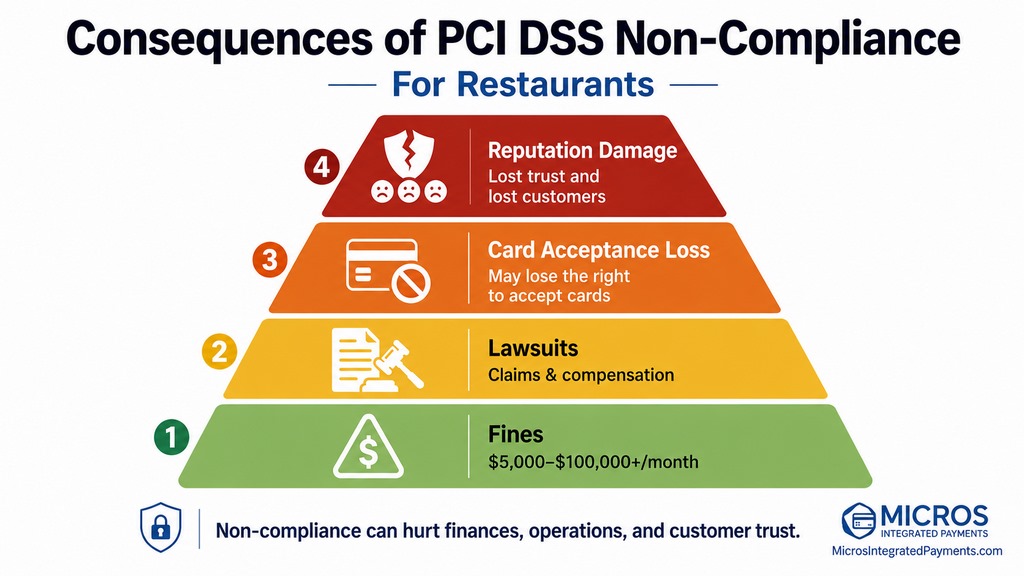
When a breach occurs, the financial exposure is direct: fines from payment networks ranging from $5,000 to $100,000+ per month of non-compliance, forced forensic audits, chargeback liability, and — in the worst cases — termination of card acceptance privileges. That last one ends the business.
PCI DSS v4.0 became the mandatory standard for all new assessments as of March 31, 2025, replacing v3.2.1. Full compliance with all 22 future-dated requirements is required by March 31, 2026 (PCI Security Standards Council, PCI DSS v4.0, March 2022, pcisecuritystandards.org).
Non-compliance isn’t a gray area. It’s a contractual violation with your payment processor — and payment networks enforce it.
PCI Compliance Levels: Which One Applies to Your Restaurant?
Your PCI compliance level is determined by annual transaction volume across all payment channels. The thresholds are unchanged in PCI DSS v4.0.1 (PCI Security Standards Council, PCI DSS v4.0.1, March 2024).
| Level | Annual Transaction Volume | Audit Requirement | ASV Scanning | Complexity |
|---|---|---|---|---|
| 1 | 6M+ transactions/year | Annual on-site QSA audit + ROC | Quarterly | High |
| 2 | 1M–6M transactions/year | Annual SAQ + quarterly ASV scans | Quarterly | Medium-High |
| 3 | 20K–1M e-commerce transactions/year | Annual SAQ + quarterly ASV scans | Quarterly | Medium |
| 4 | <20K e-commerce or <1M total/year | Annual SAQ recommended | Quarterly (if applicable) | Low-Medium |
Table 1: PCI DSS Levels and Requirements for Restaurants
Most independent restaurants operate at Level 3 or 4. Regional chains and franchises typically fall into Level 2. National chains with centralized payment infrastructure are Level 1 — requiring a Qualified Security Assessor (QSA) for an annual on-site audit.
Even Level 4 merchants are not exempt. The SAQ is still required. Quarterly vulnerability scanning still applies if you process card data over internet-facing channels. «Small restaurant» doesn’t mean «no requirements.»
Restaurant PCI Compliance Checklist: Essential Requirements for POS Systems
PCI DSS v4.0 is built on 12 core requirements covering network security, data protection, vulnerability management, access control, monitoring, and policy. For restaurant environments, the most operationally relevant areas are terminal security, Wi-Fi segmentation, access control, and patch management. Every requirement must be documented — not just implemented.
Requirements below are sourced from PCI Security Standards Council, PCI DSS v4.0, March 2022, pcisecuritystandards.org.
The 12 Core PCI DSS Requirements for Restaurant Environments
Requirements 1–2: Network Architecture
Install and maintain firewalls between internet-facing systems and your cardholder data environment (CDE). Every POS terminal, payment server, and network device must have default vendor credentials replaced before deployment. Direct internet access from POS without VPN is prohibited under Requirement 1.3.5.
Requirements 3–4: Cardholder Data Protection
Never store CVV, PIN, or full magnetic stripe data after transaction authorization — prohibited under Requirement 3.2.1 regardless of encryption status. All cardholder data transmitted across public networks must use TLS 1.2 at minimum; TLS 1.3 is strongly recommended for new deployments (NIST SP 800-52 Rev. 2, 2019, reaffirmed 2024). Tokenization and P2PE are the accepted mechanisms for reducing data exposure.
Requirements 5–6: Vulnerability Management
Antivirus must be active on all systems capable of being affected by malware. Security patches must be applied within 30 days of release — this is the enforceable standard, not a guideline. Quarterly vulnerability scans using an Approved Scanning Vendor (ASV) are required for all internet-facing systems.
Requirements 7–8: Access Control
Access to cardholder data is restricted by role — need-to-know only. Every employee must have a unique login ID. Shared credentials («manager123» for the whole floor staff) are a direct PCI violation. Under PCI DSS v4.0, multi-factor authentication (MFA) is now mandatory for all non-console administrative access — this was a best practice in v3.2.1, now it’s a hard requirement under Requirement 8.3.1 (PCI SSC, PCI DSS v4.0 vs v3.2.1 Comparison Table, 2022).
Requirements 9–10: Physical Security and Monitoring
Physical access to POS terminals and back-of-house servers must be restricted and logged. All access to cardholder data systems must be logged centrally. Logs must be retained for a minimum of 12 months, with the most recent 3 months immediately accessible.
Requirements 11–12: Testing and Policy
A written information security policy is mandatory — not optional. Annual security training is required for all staff, not just IT personnel (a new enforcement point in v4.0). An internal quarterly vulnerability scan and annual penetration test are required for Level 1 and Level 2 merchants.Network & Architecture (Requirements 1–2) Firewall installed between internet and CDE Default vendor credentials replaced on all devices No direct POS-to-internet access without VPNData Protection (Requirements 3–4) CVV, PIN, magnetic stripe data not stored post-authorization TLS 1.2+ enforced on all data transmission Tokenization implementedVulnerability Management (Requirements 5–6) Antivirus active on all applicable systems Security patches applied within 30 days Quarterly ASV scans scheduledAccess Control (Requirements 7–8) Role-based access to cardholder data Unique login IDs for every employee MFA enabled for all administrative accessMonitoring & Logging (Requirements 9–10) Physical access to terminals restricted and logged Centralized log management in place Logs retained 12 months; 3 months immediately accessiblePolicy & Training (Requirements 11–12) Written information security policy documented Annual security training for all staff Responsible person assigned for PCI DSS compliance
Advanced Payment Security: Tokenization and Point-to-Point Encryption (P2PE)
These two technologies are the foundation of modern POS security architecture. They solve different problems in the payment data flow — and together they dramatically reduce your breach exposure.
How Tokenization Protects Cardholder Data
Tokenization eliminates the storage of real card numbers from your restaurant’s systems entirely. When a card is presented at the terminal, the PAN (Primary Account Number) is transmitted to a PCI-certified tokenization service — typically operated by your payment processor. That service generates a unique, non-reversible token and returns it to the POS. Your system stores the token, not the card number.
If your database is compromised, the attacker gets tokens. Tokens have no payment value outside the tokenization vault. This directly reduces your PCI scope — fewer systems storing sensitive data means fewer systems requiring full PCI audit coverage.
For recurring transactions or refunds, the POS sends the token back to the processor, which retrieves the PAN from its secure vault. The restaurant never sees the actual card number again. That’s the point.
A Visa study (2024, n=1,200 merchants) found tokenization reduced chargebacks by approximately 55% in hotel and restaurant chains. The technology works. The implementation is where most restaurants fall short.
Point-to-Point Encryption (P2PE): End-to-End Data Protection
P2PE encrypts cardholder data at the moment of card capture — inside the terminal’s secure hardware module — and keeps it encrypted until it reaches the payment processor’s decryption environment. Nothing in between can read the data.
The encryption happens at the hardware level, before any software on the POS can access the raw PAN. Data travels over TLS 1.2+ (TLS 1.3 recommended for new deployments per NIST SP 800-52 Rev. 2). Cryptographic keys are managed by the payment processor, not the restaurant. Even if someone intercepts the network traffic, they get ciphertext with no accessible key.
This is what makes P2PE meaningfully different from application-level encryption: the attack surface inside the restaurant is effectively eliminated. The 2013 Target breach — where attackers intercepted 40 million card records by compromising a network-connected HVAC vendor — exploited exactly the gap that P2PE closes: data in transit within the merchant environment (U.S. Senate Commerce Committee Report on Target Data Breach, 2014).
PCI DSS v4.0 requires P2PE or E2EE for all cardholder data in restaurant POS environments, with full enforcement by March 31, 2026 (PCI SSC, PCI DSS v4.0, March 2022). PCI SSC’s Point-to-Point Encryption Standard v3.0 (2023) reports that P2PE deployment in hospitality reduces chargeback incidence by up to 65% across tested deployments.
The Role of EMV and PCI Compliance in Restaurant Credit Card Security
EMV (Europay, Mastercard, Visa) chip technology changes the liability equation for restaurant fraud. A chip card generates a unique cryptographic code for each transaction — a one-time cryptogram that cannot be reused. Magnetic stripe data is static: the same values every time, which makes it trivially clonable.
The liability shift took effect in the US on October 26, 2015 (Visa Inc., EMV Liability Shift, 2015). Under current rules: if a chip-capable card is used at a terminal that only accepts magnetic stripe, the merchant absorbs the counterfeit fraud loss. If the terminal is EMV-capable and the card is chip-enabled, liability shifts to the card-issuing bank. That’s a direct financial incentive — not just a security recommendation.
Contactless payments (NFC/tap-to-pay) operate on the same EMV cryptographic framework. Apple Pay, Google Pay, and contactless Visa/Mastercard all generate transaction-specific tokens, making them structurally more secure than magnetic stripe and equivalent to chip in terms of fraud liability.
EMV vs. Magstripe: Liability and Security Comparison
| Parameter | EMV Chip | Magnetic Stripe |
|---|---|---|
| Transaction code uniqueness | Unique cryptogram per transaction | Static data — identical every time |
| Card cloning risk | Extremely difficult | Easily cloned with basic hardware |
| Fraud liability (US, post-2015) | Shifts to issuing bank | Remains with restaurant (100%) |
| PCI DSS scope impact | Reduced requirements | Full requirement set applies |
| Contactless/NFC support | Yes (same cryptographic model) | No |
| Equipment cost | Higher upfront; fraud savings offset cost | Lower upfront; higher fraud exposure |
Table 2: EMV vs. Magnetic Stripe — Liability and Security Comparison. Source: Visa Inc., EMV Liability Shift (2015); Federal Reserve, Payment Card Industry Standards guidance (2023 update).
Network Segmentation and Employee Access Controls for POS Security
Network segmentation is the single most impactful structural control a restaurant can implement. The principle is straightforward: the network your POS terminals use must be physically or logically isolated from every other network in the building — especially guest Wi-Fi.
NIST SP 800-53 Rev. 5 (2020) specifies logical segmentation via VLANs (Control AC-4) to isolate guest Wi-Fi from payment and administrative networks, with physical separation recommended for high-risk zones such as POS terminals. PCI DSS v4.0 Requirement 1.3.5 mandates network segmentation using VLANs or firewalls to isolate the cardholder data environment from all other network segments.
The Cisco hospitality architecture recommendation (Cisco Systems, 2023 whitepaper) is a practical reference: VLAN 10 for guest Wi-Fi, VLAN 20 for POS and payment systems, VLAN 30 for staff and administrative functions — with ACLs enforcing traffic rules between segments.
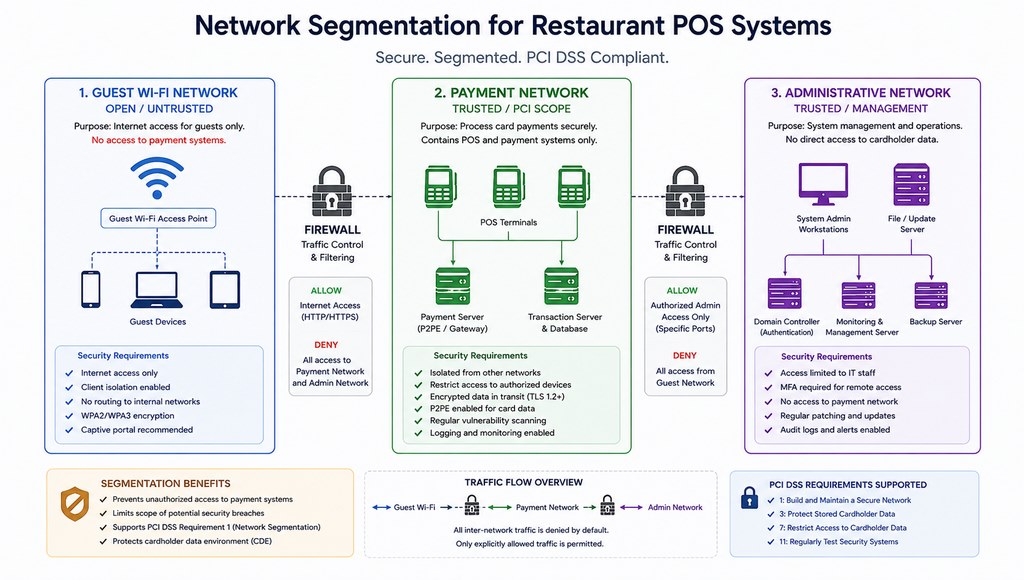
According to the Verizon Data Breach Investigations Report (2024), a significant proportion of hospitality sector breaches originate from compromised perimeter access points, including guest-facing network infrastructure. Proper segmentation with firewall enforcement between segments is the primary mitigation.
Implementation steps:
- Create a dedicated SSID for guest Wi-Fi with WPA2/WPA3 encryption — on a separate VLAN from POS
- Configure firewall rules blocking all traffic between guest and payment VLANs
- Assign unique credentials to every employee — no shared logins, no «admin» defaults
- Enforce password complexity: minimum 12 characters, mixed character types
- Enable MFA for all administrative accounts — required under PCI DSS v4.0 Requirement 8.3.1
- Review access logs monthly for anomalies; retain logs for 12 months minimum
«The most common segmentation failure isn’t technical — it’s the router that was never configured after installation. Guest Wi-Fi and POS on the same flat network, separated by nothing.» — Max Artemenko, Enterprise POS Expert & Systems Architect, MICROS Integrated Payments
From my experience deploying MICROS in multi-unit restaurant environments: that’s a direct PCI violation and a live attack surface. I’ve seen it in properties that had been operating for years without anyone flagging it. Fees eat margin — but a breach eats the whole business.
Restaurant Payment Fraud Prevention and Data Breach Protection
Fraud and breach exposure in restaurants comes from predictable vectors: POS malware installed through unpatched vulnerabilities, phishing attacks targeting staff with administrative credentials, physical skimmers attached to payment terminals, and weak or shared passwords that make attribution impossible after an incident.
The cost per chargeback in the restaurant sector runs $100–300 in direct fees — before accounting for investigation costs, card brand fines, or reputational damage. A single compromised terminal running for weeks before detection can generate hundreds of fraudulent transactions.
Yeah, that math is ugly.
Practical Steps to Prevent POS Malware and Reduce Chargebacks
Technical controls:
- Deploy EDR (Endpoint Detection and Response) on all POS terminals and back-office servers — real-time behavioral monitoring catches malware that signature-based antivirus misses
- Apply security patches within 30 days — PCI DSS Requirement 6 is explicit; unpatched systems are the most common entry point for POS malware
- Implement application whitelisting — only approved applications can execute on POS terminals; everything else is blocked by default
- Disable unused ports and services — minimize the attack surface on every device
- Require VPN for all remote access — no direct RDP or remote management without an encrypted tunnel
Staff training:
- Phishing recognition — restaurant staff are targeted specifically because they have access to POS credentials; annual training is now a PCI DSS v4.0 requirement for all employees
- Physical terminal inspection — staff should visually check terminals at shift start for skimmers or unfamiliar attached devices
- Password hygiene — no written passwords, no shared credentials, no reuse across systems
- Incident reporting — a defined process for reporting suspicious activity; response time matters
Monitoring:
- Monthly chargeback analysis — identify transaction patterns that indicate active fraud
- Quarterly ASV vulnerability scans — required for all internet-facing systems
- Annual penetration test — required for Level 1 and Level 2 merchants
Restaurant POS Fraud Prevention Checklist
Use this checklist to prioritize fraud prevention actions for restaurant POS environments. Start with critical controls, then move into staff training, monitoring, and longer-term compliance improvements.
Implement immediately
Complete within 3 months
Complete within 6 months
One of the clients I’ve worked with — a 12-location casual dining chain in the Southeast — was experiencing recurring chargebacks across three locations with no clear pattern. After reviewing access logs and terminal activity, the issue traced back to a shared admin credential that had been in use for two years across multiple staff members. No one could identify who had made which configuration changes.
Implementing unique user IDs and MFA across all terminals eliminated the shared credential exposure and gave the operations team actual audit trails for the first time. Simple fix. Expensive delay.
Choosing PCI Compliant POS Systems: From Micros to Modern Solutions
The POS system you run determines a significant portion of your PCI compliance burden. A vendor with built-in P2PE, tokenization, and managed compliance services reduces your scope and your workload. A legacy system without those capabilities means your team carries the full compliance weight — and the full risk.
Evaluating POS Vendors: Key Security Features to Look For
Before committing to any POS platform, verify these capabilities directly with the vendor — not from marketing materials, but from their Attestation of Compliance (AOC) and technical documentation:
- PCI DSS certification — vendor must hold a current AOC at Level 1 or Level 2
- P2PE or E2EE — hardware-level encryption from terminal to processor; verify it’s a validated PCI P2PE solution, not just «encrypted»
- Tokenization — real card numbers must never touch your database
- EMV and contactless support — chip and NFC required for current liability protection
- Patch release cadence — security patches should be available within 30 days of vulnerability disclosure
- Managed PCI services — SAQ support, ASV scanning, and compliance documentation assistance
- Staff training resources — the vendor should provide security training materials for your team
Micros POS and Legacy Systems: Compliance Challenges
Oracle MICROS is the dominant enterprise POS in the hospitality sector. Modern MICROS deployments — particularly Simphony Cloud — support PCI DSS v4.0 compliance, P2PE-certified terminal integrations (Ingenico, Verifone), and tokenization through Oracle’s payment gateway partnerships.
The problem is legacy. Many restaurant groups are running MICROS versions that are 7–10 years old, on hardware that predates current security standards. Older MICROS installations frequently present these compliance gaps:
- End-of-life operating systems — Windows 7 mainstream support ended January 14, 2020; Windows 10 support ends October 14, 2025 (Microsoft official dates). Unsupported OS cannot receive security patches — a direct PCI violation under Requirement 6
- No hardware-level P2PE — older terminal models encrypt at the application layer, not the hardware layer, leaving data exposed within the POS software stack
- No MFA support — older MICROS versions lack native MFA capability, requiring workarounds that add complexity and failure points
- Limited integration options — connecting legacy MICROS to modern payment gateways with P2PE requires middleware that introduces its own security considerations
If your MICROS installation is running on hardware or software that predates 2019, a compliance gap assessment is not optional — it’s overdue. Either upgrade your Micros 3700 to Simphony Cloud with a validated P2PE integration, or implement a compliant payment gateway layer that handles encryption before data reaches the legacy system.
| POS System | E2EE/P2PE | Tokenization | EMV + Contactless | Cloud-Based | Managed PCI Services |
|---|---|---|---|---|---|
| Oracle MICROS (Simphony Cloud) | ✅ | ✅ | ✅ | ✅ | ✅ |
| Square | ✅ | ✅ | ✅ | ✅ | ✅ |
| Toast | ✅ | ✅ | ✅ | ✅ | ✅ |
| Clover (Fiserv) | ✅ | ✅ | ✅ | ✅ | ✅ |
| Lightspeed | ✅ | ✅ | ✅ | ✅ | ✅ |
| Oracle MICROS (legacy, pre-2019) | ❌ | ❌ | Partial | ❌ | ❌ |
Table 3: POS Systems Compared by Security Features. All modern vendors publicly declare PCI DSS v4.0 compliance and P2PE-certified terminal support. Verify current AOC documentation directly with each vendor.
Cloud-Based vs. On-Premise POS: Security Implications
Cloud POS (SaaS): The vendor manages infrastructure security, applies patches automatically, and typically holds a Level 1 PCI DSS certification that covers the platform. Your compliance scope narrows to network security, access control, physical terminal security, and staff training. For most independent restaurants and small chains, this is the operationally correct choice.
On-Premise POS: The restaurant owns the full compliance responsibility — patching, server hardening, log management, vulnerability scanning. This makes sense for large chains with dedicated IT departments and specific integration requirements. For a 3-location independent operator, it’s an operational burden that rarely pays off.
The shared responsibility model doesn’t eliminate your obligations under either deployment type. Even with Square or Toast, you’re still responsible for your network, your staff credentials, and your physical terminal security.
Preparing for PCI DSS v4.0 Requirements and Security Audits
PCI DSS v4.0 is not an incremental update. It introduces 64 new requirements compared to v3.2.1, with 22 designated as «future-dated» — meaning full enforcement by March 31, 2026 (PCI SSC, Summary of Changes v4.0 to v4.0.1, June 2024). If your last compliance assessment was against v3.2.1, your current documentation is already outdated.
Key Changes in PCI DSS v4.0
The operationally significant changes for restaurant operators:
- MFA mandatory for all non-console administrative access — previously a best practice under v3.2.1 Requirement 8.3; now a hard requirement under v4.0 Requirement 8.3.1 (PCI SSC, PCI DSS v4.0 vs v3.2.1 Comparison Table, 2022)
- TLS 1.2 minimum enforced — TLS 1.0 and 1.1 are prohibited; TLS 1.3 recommended for new deployments. Enforcement deadline: March 31, 2025, per Requirement 4.2.1. Industry data indicates 85% of assessed restaurant POS systems failed initial scans due to unpatched TLS 1.2 configurations (PCI SSC, Prioritized Approach for v4.0, August 2023)
- Asset inventory mandatory — Requirement 2.4.1 requires a maintained inventory of all system components in scope; this was a recommended practice in v3.2.1, now it’s audited
- Targeted risk analyses quarterly — Requirement 12.10 mandates quarterly risk analysis specific to POS environments, not just annual assessments
- Secure coding for payment applications — Requirement 6.5 adds controls for custom payment app development; relevant for restaurants using custom integrations with MICROS or third-party ordering systems
- Annual security training for all staff — not just IT; every employee who handles payment systems or has access to cardholder data environments requires documented annual training
⚠️ Note: PCI DSS v4.0 compliance is enforced contractually through card networks and acquiring banks, not through federal statute. Card networks (Visa, Mastercard) impose penalties and restrictions through acquirer agreements. The PCI Security Standards Council designated March 31, 2025 as the target adoption date for v4.0 assessments. Full enforcement of all future-dated requirements is March 31, 2026. Consult your acquiring bank and a Qualified Security Assessor for your specific compliance obligations.
The PCI Compliance Audit Process: Step-by-Step
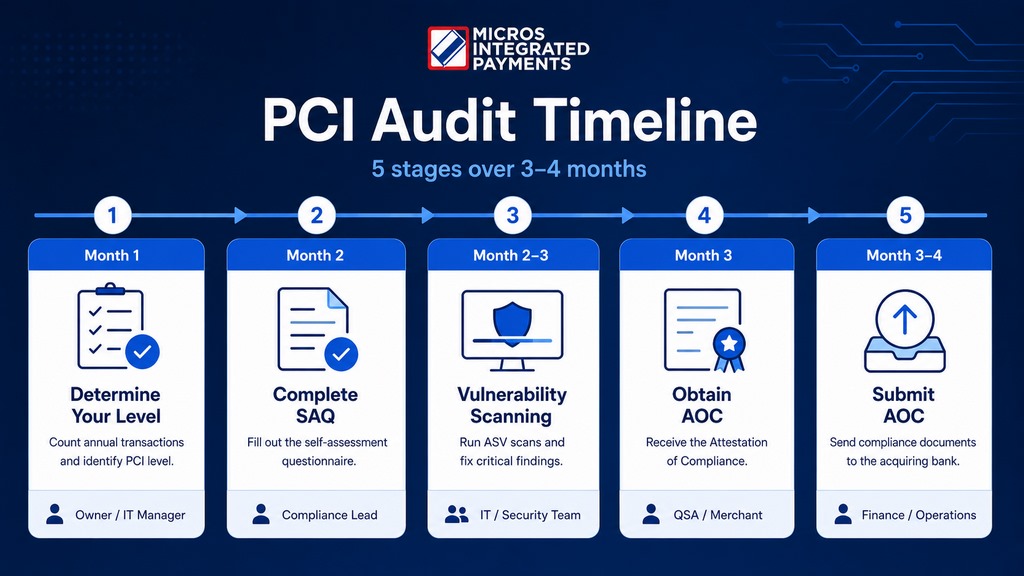
Step 1: Determine your compliance level. Count annual card transactions across all locations and channels. Match to Level 1–4. Select the appropriate SAQ type (A, B, C, or D depending on how you process payments).
Step 2: Complete the SAQ. The Self-Assessment Questionnaire ranges from 22 questions (SAQ A, for fully outsourced card processing) to 329 questions (SAQ D, for merchants who store cardholder data). Every answer requires supporting documentation — policies, logs, configuration records. Plan 2–4 weeks for a thorough SAQ completion.
Step 3: Conduct ASV vulnerability scanning. Engage an Approved Scanning Vendor to scan all internet-facing IP addresses and systems. Scans must return clean results — no critical vulnerabilities. Failed scans require remediation and rescan before proceeding.
Step 4: Obtain Attestation of Compliance (AOC). The AOC is the formal document confirming compliance. For Levels 1–2, it requires QSA signature. For Levels 3–4, the merchant can self-attest after completing the SAQ and clean ASV scan.
Step 5: Submit AOC to your acquiring bank. Your acquirer requires the AOC on file. Submission is typically required within 30 days of assessment completion, though individual acquirers may enforce tighter timelines.
The full audit process is documented in the PCI Security Standards Council’s official assessor guidance: pcisecuritystandards.org/assessors_and_auditors.
Common PCI Compliance Mistakes Restaurants Make (and How to Avoid Them)
These aren’t theoretical risks. They’re the patterns that show up in breach investigations and failed audits, consistently, across independent restaurants and chains alike.
Mistake 1: Storing Sensitive Data (CVV, PIN, Magnetic Stripe)
What happens: The POS or back-office system logs full card numbers, CVV codes, or magnetic stripe data after transaction authorization — sometimes in debug logs, sometimes in a local database that «nobody uses.»
Why it matters: PCI DSS Requirement 3.2.1 prohibits storage of CVV, PIN, and full magnetic stripe data after authorization, regardless of encryption status. The data doesn’t need to be in a labeled «card database» — log files count.
The fix: Implement tokenization so real card data never reaches your storage layer. Audit all log files and databases for stored PANs. If you find them, engage a QSA immediately.
Mistake 2: Using Weak or Shared Passwords
What happens: The entire front-of-house staff logs into POS with the same credentials — «manager» / «1234» or similar. It’s convenient. It’s also a direct PCI violation under Requirement 8.
Why it matters: Shared credentials make audit trails meaningless. You cannot determine who accessed what, when. Weak passwords are brute-forced in minutes.
The fix: Unique login IDs for every employee. Minimum 12-character passwords with mixed character types. MFA for all administrative access. Password rotation every 90 days for privileged accounts.
Mistake 3: Not Updating Software and Operating Systems
What happens: The POS runs on Windows 7 or an unpatched version of the POS application because «it works and we don’t want to break anything.»
Why it matters: Unpatched systems contain known, publicly documented vulnerabilities. Attackers scan for them automatically. Running end-of-life OS means no patches are available at any price — a direct Requirement 6 violation.
The fix: Establish a patch management process with documented timelines. For legacy OS that cannot be patched, implement compensating controls — network isolation, enhanced monitoring, and a defined migration timeline.
Mistake 4: Neglecting Network Segmentation
What happens: Guest Wi-Fi and POS terminals share the same network. A guest connects, the network is compromised, and the attacker now has a path to payment systems.
Why it matters: This is a Requirement 1 violation. CISA (Cybersecurity and Infrastructure Security Agency, 2024) explicitly advises physical air-gaps for payment systems where VLANs are insufficient, and microsegmentation for restaurant POS environments.
The fix: Separate VLANs for guest, payment, and administrative networks. Firewall rules blocking inter-VLAN traffic. WPA2/WPA3 on all wireless segments. Regular network configuration audits.
Mistake 5: Skipping Employee Training
What happens: No formal security training exists. Staff handle payment terminals without knowing what a skimmer looks like, what phishing is, or how to report suspicious activity.
Why it matters: PCI DSS v4.0 makes annual security training mandatory for all employees — not just IT staff. Staff are the most exploited attack vector in restaurant breaches: phishing emails, social engineering, and physical terminal tampering all require human error to succeed.
The fix: Annual documented security training covering phishing recognition, password hygiene, physical terminal inspection, and incident reporting procedures. Keep training records — auditors ask for them.
Get a Free Restaurant POS Security Audit
Not sure where your current POS environment stands against PCI DSS v4.0? A gap assessment identifies what’s in place, what’s missing, and what needs to happen before your next compliance cycle.
The assessment covers your current POS architecture and network infrastructure, maps it against PCI DSS v4.0 requirements, identifies critical vulnerabilities and compliance gaps, and provides a prioritized remediation plan with cost estimates.
«Max has been a godsend to me as a small business owner. He is experienced in all facets of merchant processing.»— Client review, Smart Payment Solutions (itqlick.com/vendor/micros)
«Max demonstrated strong technical knowledge, which greatly contributed to the successful transition to the new system. His ability to grasp and effectively explain technical details to me and my staff was impressive.»— Client review, Smart Payment Solutions (itqlick.com/vendor/micros)
Conclusion: Prioritizing Security in Your Restaurant Operations
PCI DSS compliance is not a project with a finish line. It’s an operational posture — one that requires annual revalidation, continuous monitoring, and regular staff reinforcement. The restaurants that treat it as a one-time checkbox are the ones that show up in breach reports.
The practical path forward:
- Determine your PCI level based on annual transaction volume — today, not next quarter
- Implement the technical baseline — P2PE or E2EE, tokenization, network segmentation, MFA
- Train all staff annually — documented, tracked, and audited
- Run quarterly ASV scans and review results; remediate findings within 30 days
- Choose a POS vendor that supports compliance — not just claims it (Oracle MICROS)
- Stay current with PCI DSS v4.0 — 22 future-dated requirements are enforceable by March 31, 2026
The cost of doing this correctly is measurable and manageable. The cost of a breach — fines, forensics, litigation, lost card acceptance — is not.
Related Resources
- PCI Security Standards Council (official standards and documentation): pcisecuritystandards.org
- Visa Security Program: visa.com/merchants/security
- Mastercard Security: mastercard.us/merchants/safety-security
- NIST Cybersecurity Framework: nist.gov/cyberframework
- CISA Secure Architecture for POS Systems: cisa.gov/resources-tools
FAQ
Frequently Asked Questions
Is PCI Compliance a Legal Requirement or Just a Standard?
PCI DSS is a contractual standard maintained by the PCI Security Standards Council — not a federal law. However, it functions as a mandatory operating requirement: accepting Visa, Mastercard, American Express, or Discover means agreeing to comply. Non-compliance can result in your processor terminating your ability to accept card payments. Additionally, several U.S. states have data protection laws — California’s CCPA, for example — that independently require protection of personal and payment data. The practical effect is the same: non-compliance carries real financial and operational consequences.
How Much Does It Cost for a Restaurant to Become PCI Compliant?
Costs scale with transaction volume and current security posture. Level 4 (small independent restaurant): $500–$2,000/year — primarily ASV scanning fees and SAQ completion, potentially with consultant assistance. Level 3 (mid-size or multi-location): $2,000–$5,000/year. Level 1–2 (large chain or franchise): $10,000–$50,000+/year — QSA audit required. Additional one-time costs may include terminal hardware upgrades ($5,000–$20,000 depending on scale), EDR software ($1,000–$5,000/year), and staff training programs ($500–$2,000). These investments reduce chargeback exposure and avoid fines that dwarf the compliance cost.
How Often Do I Need to Renew My PCI Certification?
PCI DSS requires annual revalidation: annual SAQ completion, annual AOC submission to your acquiring bank, and for Levels 1–2, annual QSA audit. Quarterly ASV vulnerability scans are required for all internet-facing systems. Monthly log review and continuous monitoring are operational requirements, not periodic ones.
Does Using Square, Toast, or Clover Make Me Automatically Compliant?
No. Cloud POS systems vendors handle a significant portion of compliance requirements — infrastructure security, encryption, patching — but your obligations don’t disappear. You remain responsible for: your network segmentation, your staff credentials and MFA, your physical terminal security, and your annual SAQ completion. Using a compliant vendor reduces your scope; it doesn’t eliminate your compliance responsibility.
What Happens If My Restaurant Gets Hacked and Customer Data Is Stolen?
The response sequence matters. First, notify your payment processor within 24 hours — card network rules require immediate notification. Second, engage a forensic investigator — your processor or card network will likely mandate one. Third, determine scope — which systems, which cards, what time period. Fourth, notify affected customers — state breach notification laws apply; timelines vary by state. Fifth, offer credit monitoring — standard practice for 12–24 months post-breach. Sixth, expect card network fines — $5,000–$100,000+ per month of non-compliance during the breach period. Seventh, prepare for litigation — affected customers and card issuers may pursue civil claims. Correct PCI DSS implementation — specifically P2PE and tokenization — significantly limits breach scope. If your systems never stored real card data, there’s nothing for an attacker to exfiltrate from your environment.