
Updated for 2026. Prices and product details reflect current Oracle public materials and market data available at time of publication.
TL;DR — What you need to know before reading:
- Simphony Essentials starts at $55/month per terminal; Plus at around $75/month — but neither is a universal flat rate.
- Hardware, setup, integrations, support, and payment processing are all separate budget lines.
- Oracle does not publish a single all-in price card. Expect a quote-driven process.
- If you are migrating from RES 3700, Microsoft ended Windows 10 support on October 14, 2025 — making legacy hardware a security liability regardless of software choice.
- The real comparison is 3-year total cost of ownership, not monthly subscription alone.
If you are trying to figure out Oracle Micros Simphony pricing before talking to sales, the short answer is this: there is no clean public all-in price card. In 2026, Oracle still presents Simphony as a metered cloud service with edition-based and usage-based components, while much of the real project cost is quote-driven and depends on hardware, rollout scope, integrations, payment setup, and support structure.
“When owners ask me how much Simphony costs, the honest answer is: the subscription is only one line on the budget. The real number comes from how many workstations you need, what hardware you put on the floor, what has to integrate, and who will support it after go-live.” — Max Artemenko, POS Systems Expert & Product Architect
That is the gap this guide is meant to close. Oracle publishes service structure and some public entry signals, but not a universal restaurant-ready budget. Oracle’s public price materials show Simphony as a metered service with separate line items — edition, environment, and transaction-related fees — rather than one flat MSRP for every restaurant setup, according to the Oracle Cloud Price List and Oracle Integration Pricing pages (Oracle Cloud Price List, Oracle Integration Pricing).
This article focuses on the budget logic behind oracle micros simphony pricing in the U.S. for 2026. It also uses a practical restaurant lens: one terminal is not the same as five, and a clean new install is not the same as a RES 3700 migration with menu rebuilds and third-party connectors.
What Oracle Micros Simphony pricing usually includes
Oracle Micros Simphony pricing usually includes more than software. A workable budget needs to cover the SaaS subscription, workstation licensing logic, hardware, implementation, support, payment processing costs, and any integration fees that sit outside the base POS service.
The strongest verifiable public point is that Oracle exposes Simphony as a componentized cloud service. According to Oracle’s official catalog, the pricing structure references edition-level services and metered items — not a single all-in package price:
“Oracle MICROS Simphony Cloud Service, Single-Tenant Edition includes an environment fee and tiered transaction fees for the first 200 processed customer transactions per month.” — Oracle Cloud Price List, 2026 (source)
Oracle Micros Simphony Pricing Components
Cost component How it usually appears One-time or recurring What to watch for
SaaS subscription Simphony cloud service edition Recurring monthly Edition, transaction model, quote structure
Per-workstation licensing POS client/workstation count Recurring or bundled in quote What Oracle counts as a workstation
Hardware Terminals, tablets, printers, payment devices, network gear One-time or financed Terminal class, support, warranty, replacement terms
Installation and menu programming Deployment labor, configuration, menu build One-time Scope creep, revisions, multi-location complexity
Integration fees Online ordering, loyalty, accounting, middleware, API work One-time and sometimes recurring Connector licensing, custom mapping, testing
Support contract Help desk, after-hours support, software/hardware support Recurring Response times, remote vs onsite, exclusions
Payment processing costs Card-present and card-not-present acceptance Recurring variable Effective rate, gateway path, chargeback fees
Under Oracle’s public structure, the clearest way to think about micros pos pricing is as a stack. First comes the software layer. Then the device layer. Then the rollout layer. Then the operating layer. Owners get in trouble when they only compare the first layer.
In one migration planning scenario I have seen repeatedly, the buyer focuses on software first because that is the only number visible early. Then hardware, menu programming, and payment rails show up later — and the project budget changes shape. The result is not fraud. It is just incomplete scoping.
For details on payment processing costs and what to look for in restaurant merchant agreements, see Payment Processing for Restaurants.
Subscription and workstation-based fees
Simphony uses a cloud subscription model, but the monthly charge is not presented by Oracle as one simple public self-serve POS fee for every use case. Oracle’s integration catalog describes Simphony as a Metered Service, which means the billing logic is tied to service units and configuration — not just a sticker price per terminal:
“Oracle Simphony is listed as ‘Metered Services’ in Oracle’s integration pricing catalog, confirming that cost depends on service units and transaction volume rather than a fixed MSRP.” — Oracle Integration Pricing, 2024 (source)
This matters because the search intent behind simphony subscription cost per terminal, oracle micros simphony cloud pricing per terminal monthly, and oracle micros simphony subscription fee per workstation assumes a fixed SaaS number. In practice, Oracle’s public materials support the existence of recurring subscription logic, but not a universal public monthly workstation rate across all editions.
So how should an operator read this? Treat the monthly software line as a recurring service fee that scales with deployment structure. If a quote is built around workstations, every added workstation affects the recurring cost basis. If a quote is built around edition plus usage layers, transaction volume and environment structure also matter.
From an implementation perspective, the practical question is not “Is it billed per terminal or per workstation?” The practical question is: “What device types are counted, and what add-on service units are triggered by this configuration?”
One-time setup and ongoing operating costs
One-time setup costs are usually where Simphony budgets become real. Ongoing operating costs are where they stay real.
Oracle documentation confirms the existence of configuration work around payments, tenders, service charges, and menu setup, but it does not publish a universal public price card for installation and menu programming. The available evidence shows the structure, not a fixed number, which is why setup and support are usually quoted case by case (Oracle Simphony Configuration Guide, 2025).
On the payments side, Oracle states fixed fees and no annual contract for its payment processing offer, but public merchant rate detail is not fully disclosed. That means payment processing costs should be treated as a separate recurring operating line, not assumed to be safely absorbed in software. For market context, payment processing fees for comparable enterprise POS systems typically range from 2.4% to 2.9% per transaction — use this as a planning reference, not an Oracle guarantee.
“Max is always ready to help with chargebacks, responds quickly and processes all documents. We have been working with him for many years.” — Client review, Case #9 & #15, Micros Integrated Payments
A practical budget often includes:
- installation and staging labor
- menu programming
- tax and tender setup
- handheld or tablet setup
- payment device boarding
- staff training
- support contract
- payment processing costs
- integration validation and connector setup
That is why micros pos system cost is rarely just the software number.
Simphony plans and editions: Essentials vs Plus
The two plan names that matter most in public discussion are Simphony Essentials and Simphony Plus. Essentials is positioned for smaller restaurant operations, while Plus is associated with a broader operating scope and more modules.
Oracle documentation describes Essentials as a solution for small- and medium-sized restaurants, with a pay-as-you-go metered model. Plus is the higher edition for broader deployments, with access to additional modules including Oracle Restaurants Reporting and Analytics and Oracle Restaurants Labor Management (Oracle Simphony Essentials docs, Oracle Cloud Price List).
Simphony Essentials vs Simphony Plus: Key Differences
Area Simphony Essentials Simphony Plus
Typical fit Smaller restaurants, simpler deployments Multi-unit, broader operations
Pricing visibility Public starter signals exist ($55/mo) Often quote-led, less transparent (~$75/mo)
Licensing logic Cloud subscription, per POS client, metered Cloud subscription with broader module scope
Included modules Core POS, Configuration Environment Core POS + Analytics + Labor Management
Cost drivers Terminal count, setup, payments Terminal count, modules, integrations, rollout complexity
Best for Operators who need core POS without enterprise sprawl Franchises, chains, more layered operating environments
This is where simphony essentials pricing gets so much search demand. Buyers want an anchor before the sales call. That is reasonable. The problem is that the anchor does not equal the full budget.
Simphony Essentials pricing for smaller operations
Essentials is the clearest entry point in public messaging. The main public starter figure associated with Essentials in 2026 is “as little as $55/month”, confirmed in Oracle’s own promotional PDF for Simphony Essentials (Oracle Simphony Essentials POS for Restaurants, 2026). However, Oracle’s broader public price structure still presents Simphony through metered and edition-based service logic rather than one universal flat restaurant tariff — meaning Oracle’s official price list marks many line items as N/A or custom.
That means the safest interpretation is this: Simphony Essentials may start at $55 per month in Oracle’s public promotional language, but the final monthly amount still depends on deployment specifics and quote structure. Oracle’s price list additionally shows metered components for Revenue Center Fee and Transaction Fee within the Essentials Edition, which means the actual monthly charge can scale beyond a simple per-terminal starter figure.
If you run one smaller location, the monthly software line can stay understandable. Once you add more devices, more revenue centers, integrations, or advanced operating needs, the budget moves away from starter pricing.
Example only: 1-terminal Essentials scenario
- Base subscription signal: from $55/month
- Hardware: quote-based or promo-based
- Setup: depends on menu size and install scope
- Processing: separate recurring cost (market reference: 2.4%–2.9%)
- Support: may be separate or packaged
This is why a small restaurant asking how much does micros pos cost should not stop at the starter line. That line is a threshold, not a deployment budget.
Simphony Plus for broader restaurant operations
Simphony Plus usually means broader restaurant operations and broader cost drivers. In public discussion, Plus is often associated with larger deployments, more modules, and more operational depth.
Market summaries commonly reference Plus at $75/month as a planning anchor, though Oracle’s official price catalog does not present a universal per-terminal MSRP for Plus — so that figure should be treated as a secondary market reference, not a guaranteed Oracle quote. For enterprise or multi-location deployments, Plus pricing is typically custom and quote-driven.
Third-party analysis estimates annual Plus costs at roughly $9,000 for 10 users and $90,000 for 100 users when scaled linearly — though these are industry planning estimates, not Oracle commitments (PricingNow, 2025/2026).
In chain environments, total cost expands for reasons that have nothing to do with the base subscription alone:
- more devices and employee roles
- more menu entities and permissions
- more integrations
- more rollout coordination and training
- more support needs across locations
In one multi-unit planning case, the software line looked manageable at first glance. Then the real costs appeared in deployment sequencing, payment routing, and connector work across locations. The result was still workable — but only after the owner stopped treating Plus like a simple “higher monthly plan” and started treating it like an operating system for multiple stores.
That shift in thinking is the difference between a budget that holds and one that blows up in month three.
How much Micros POS costs per terminal or workstation
If the direct question is “how much Micros POS costs per terminal or workstation,” the honest answer is: there is no single official public number that covers every Simphony deployment. Oracle’s own public materials support a metered and configuration-based model, while market-facing summaries often compress that into per-terminal language for easier selling.
That is the central tension in oracle micros simphony cloud pricing per terminal monthly searches. Public demand wants one number. Oracle procurement logic gives you a structure instead (Oracle Cloud Price List, Oracle Integration Pricing).
Per-terminal monthly pricing in a cloud setup
For cloud budgeting, the clearest public entry signal tied to Simphony Essentials is the from $55/month figure from Oracle’s own promotional materials. Oracle’s public catalogs do not validate a universal one-size-fits-all monthly cloud rate per terminal across all Simphony editions.
So the practical answer is:
- Essentials: public starter signal exists ($55/month per workstation, per Oracle PDF)
- Plus and broader enterprise setups: quote-based logic is more common (~$75/month in market summaries)
- Final monthly cost: scales with the number of deployed clients/workstations and attached service structure
Example only: monthly software estimate
Monthly Simphony Software Cost by Deployment Size
Deployment Public planning anchor Better interpretation
1 terminal, simple setup From $55/month Minimum entry signal, not full monthly ownership
5 terminals, same location 5 × starter signal as rough floor Actual quote may add service layers, support, and connectors
Multi-location Not reliable as a flat multiplier Needs edition, modules, rollout, and integration scoping
That distinction saves time. It also avoids false comparisons against lighter SMB POS tools that publish flat self-serve pricing — such as Toast (starting at $0/month with processing fees) or Square ($0/month software, 2.6% + 10¢ per transaction).
Per-workstation licensing and what counts as a workstation
A workstation in Oracle language is a licensing unit, not just a countertop terminal shape. That is important for budgeting because a device may affect license count if it is configured as a POS client.
Oracle licensing documentation defines a workstation as the client computer from which the program is accessed — regardless of where the program is physically installed. Oracle Simphony documentation also ties tablets into the workstation framework when configured as a Tablet Client (Type 6) in the Workstations module. In plain English, a tablet is not “free” because it is mobile. If it acts like a workstation client, it counts like one.
“Workstation” is the client computer from which the programs are being accessed, regardless of where the Program is installed. — Oracle License Definitions and Rules Booklet
That is why oracle micros simphony subscription fee per workstation can be the more accurate budgeting phrase than “per terminal.” Terminal is how operators speak. Workstation is often how licensing gets interpreted.
This is a common budget trap. A restaurant plans for two front-counter stations and later adds tablets, expo access, or backup stations. The floor gets faster, but the licensing count and support footprint also grow — and Oracle’s documentation explicitly instructs operators to update the Workstations Client License Count parameter whenever workstations are added or removed.
I have seen this catch operators off guard more than once. You add two tablets for tableside ordering during a busy season, and suddenly the licensing conversation comes back up. Plan for it upfront.
Hardware costs: terminals, tablets, and station options
Hardware can move a Simphony project from manageable to expensive very quickly. Oracle does not publish a universal public MSRP for standard restaurant hardware, so buyers usually work with partner quotes, promo terms, or reseller market references.
Two important realities for 2026: First, Oracle publicly promotes $1 hardware switching offers in some materials — including a one-year warranty — with optional premier support at 15% or parts exchange at 12% of net hardware selling price per year. Second, official public hardware list pricing is not broadly disclosed. That means oracle pos system price and micros tablet price are usually quote-driven unless a promo applies.
A complete terminal setup — including the workstation, kitchen printers, cash drawer, payment device, and network gear — can range from $2,500 to $8,000 depending on peripherals and configuration requirements. This is a market planning reference, not an Oracle MSRP.
Workstation 8, Express Station, and tablet-based setups
The main budgeting difference here is role. Full-size stations like Workstation 8 are built for fixed service positions. Compact or mobile device setups change both hardware spend and workflow design.
The Workstation 8 is a 14-inch FHD touchscreen restaurant POS terminal with Intel Celeron J6413 quad-core processor, 8 GB RAM, 128 GB SSD (Oracle Linux) or 256 GB SSD (Windows 10 IoT), Wi-Fi 6E optional, and IP54 rating for restaurant environments. Oracle does not publish an official MSRP, but market reseller references place it in the $1,800–$2,200 range per unit as a non-MSRP planning estimate (Micros Integrated Payments, 2026). For full specifications and configuration options, see Micros Workstation 8 Series.
Express Station is documented in Oracle-related materials as a compact restaurant POS line, but a current official public price point was not available in current market sources.
For mobile setups, Oracle’s Tablet 700/722 Series appears in product materials with Oracle’s $1 switching offer applying to tablets as well. Secondary sources place tablet hardware in a broad range of $149–$799 depending on configuration — not a clean pricing baseline, but a useful planning signal.
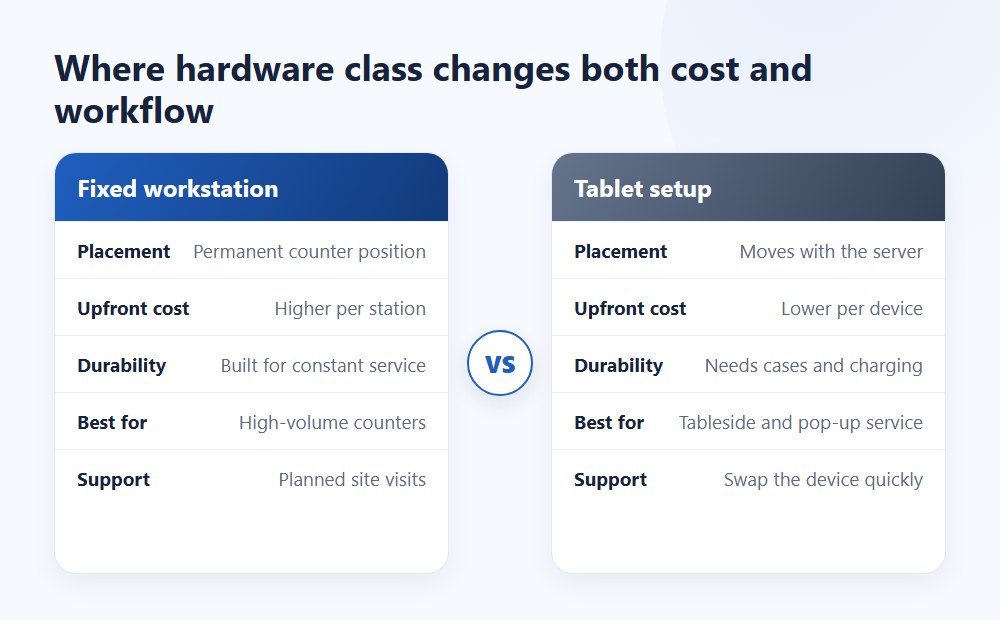
In a quick-serve environment, tablets may lower upfront station cost or improve line-busting. In full-service dining, fixed stations may still make more sense at host, bar, and service points. Hardware choice is not just about device price — it is about order flow, durability, replacement risk, and how staff actually work during peak hours.
Buying vs leasing POS hardware: risks and considerations
Buying hardware means higher upfront cash use and clearer ownership. Leasing or financing spreads cash impact, but the full multi-year spend can rise depending on terms.
No reliable public Oracle monthly lease schedule for standard Simphony hardware is available in current market sources. Any purchase-vs-lease comparison should therefore be quote-based and reviewed with the vendor in writing.
Rather than a numeric comparison that cannot be verified, here are the key risk factors to evaluate in any lease agreement:
- Contract length: Oracle lease terms are typically 2–3 years. Early termination penalties can be substantial.
- Elevated processing rates: Some “hardware for $1” or low-cost lease offers are structured to recover cost through higher payment processing rates — often 0.3%–0.5% above market rates for the contract term.
- Ownership at end of term: Clarify whether you own the hardware at lease end, or whether there is a balloon payment or mandatory return.
- Replacement and warranty terms: Confirm what happens if a device fails mid-lease — slow replacement support can cost more in floor disruption than the financing premium you were trying to avoid.
From a practical standpoint, the decision is usually operational, not ideological:
- Buy when cash is available and equipment life is expected to run several years.
- Finance when preserving cash matters more than lowest lifetime hardware spend.
- Verify replacement, warranty, and support terms before comparing numbers.
One thing I always tell operators: the $1 hardware headline is real, but read the processing rate attached to it. Fees eat margin. A slightly higher hardware cost upfront can be cheaper than a 0.4% processing markup across three years of card volume.
How does Simphony compare to Toast and Square?
Before committing to a Simphony budget, it is worth understanding where it sits in the broader market. The comparison is not just about monthly software cost — it is about total economics and fit.
Simphony vs Toast vs Square: Quick Comparison
System Starting software cost Payment processing Hardware model Best for
Oracle Simphony Essentials From $55/month per terminal Negotiated / custom (market ref: 2.4%–2.9%) Purchased or $1 promo; $2,500–$8,000 full setup Mid-size to enterprise restaurants, hotels
Toast From $0/month (Starter) Included in plan; rates vary by tier Toast-proprietary hardware required Restaurant-first SMB to mid-market
Square $0/month software 2.6% + 10¢ per transaction Square hardware; some free with plan Counter service, simple operations
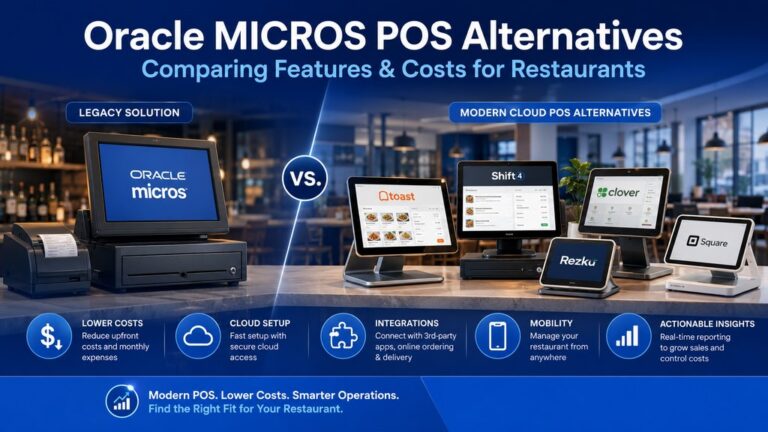
The key distinction: Toast and Square publish flat self-serve pricing because they are designed as self-serve products. Simphony is priced as an operating platform — which means deeper functionality, enterprise integrations, and significantly more configuration complexity. Simphony’s real competition is not Square. It is Aloha, Lightspeed Restaurant at scale, and other enterprise POS platforms.
For operators considering a move from Simphony to Toast or Square, the critical question is not monthly subscription. It is: does the lighter tool support your operating complexity, your integrations, and your support requirements at the same level? For most single-location independents, the answer might be yes. For a 15-unit franchise group, probably not.
Migrating from RES 3700: what changes in 2026
If you are running a legacy Micros RES 3700, the decision about Simphony is more urgent in 2026 than in previous years. Oracle no longer sells the RES 3700 and has moved all restaurant POS development to Simphony. What remains for RES 3700 is sustaining support — Oracle still addresses existing issues, but no new patches or security certifications are being built.
More critically: Microsoft ended Windows 10 support on October 14, 2025. Many older Micros RES 3700 setups run on Windows. This makes legacy hardware a direct PCI compliance liability — not a hypothetical future risk, but an active security exposure that auditors are already flagging in 2026. Keeping an unsupported OS in a card-present payment environment means more workarounds and more explaining at each audit cycle.
Beyond software, the parts problem compounds every year. Service firms that work with legacy Micros hardware describe the spare-parts pool as shrinking refurbished stock. When a board fails mid-service, you are sourcing a used part — with no guaranteed availability or timeline.
The connectivity gap is equally important. Every modern ordering channel — third-party delivery, online ordering, loyalty platforms, QR menus — is built to integrate with cloud POS systems. Open any major integration catalog and you will find Toast, Square, and Clover listed by default. RES 3700 is almost never there natively. When it does connect, it runs through middleware with its own fee and its own ways to fail during a Friday dinner rush.
For guidance on planning a RES 3700 migration, see Oracle Micros 3700 Hardware Upgrade.
Considering an upgrade? Get a free assessment.
Planning a system upgrade or moving off RES 3700? The team at Micros Integrated Payments works with restaurants and multi-unit operators across the U.S. to scope migrations, source hardware, and set up payment processing with transparent rates — no hidden markups, no surprise fees after go-live. Free EMV terminals and contactless solutions are available for qualifying Simphony deployments, with 24/7 technical support included.
Request a free TCO estimate → microsintegratedpayments.com/contact/
Total cost of ownership over 3 years
The real way to evaluate Simphony is by total cost of ownership over 3 years, not by headline subscription alone. A useful 3-year model includes software, hardware, setup, support, integrations, and payment processing costs.
Oracle’s public materials support the idea that Simphony TCO must be modeled case by case because pricing is metered and configuration-dependent, not expressed as one uniform deployment number (Oracle Cloud Price List, Oracle Integration Pricing).
Data freshness note: pricing structure, support contract terms, hardware promos, and integration fees can vary by partner, market, timing, and configuration. This guide reflects current 2026 market data and Oracle public materials and should be validated against a written quote before purchase.
3-year TCO formula
TCO = 36 months of software + hardware + implementation + integrations + support + payment processing + replacement/contingency
Example only: 1-terminal restaurant
3-Year TCO Estimate: 1-Terminal Simphony Deployment
Cost line Example assumption 3-year example
Software $55/month starter anchor $1,980
Hardware 1 device package, quote-based $2,000–$3,000
Setup Basic install and menu programming $500–$2,000
Integrations None or minimal $0–$1,000+
Support Varies by quote $500–$1,500/yr est.
Processing 2.4%–2.9% market reference Varies with volume
Example reading: a basic 1-terminal Simphony deployment may start looking reasonable on subscription alone, but real 3-year cost moves materially once hardware, setup, and processing are added.
Example only: 5-terminal restaurant
3-Year TCO Estimate: 5-Terminal Simphony Deployment
Cost line Example assumption 3-year example
Software 5 × $55/month starter anchor $9,900
Hardware 5-device deployment $10,000–$15,000
Setup Larger menu, more staging, more training $2,000–$8,000
Integrations Ordering, loyalty, accounting, delivery $1,000–$4,000+
Support Multi-device support structure $1,500–$4,000/yr est.
Processing 2.4%–2.9% market reference Varies with volume
This is where owners usually feel the difference between a quoted POS project and a public app subscription.
A short example from rollout work: one operator first modeled only software and countertop terminals. During discovery, online order flow, printers, payment devices, and menu build labor were added. The budget increased before signing, but the project launched with fewer surprises and fewer emergency purchases in the first 60 days. That is the value of scoping everything upfront — even when the conversation is uncomfortable.
“The available Oracle pages support only the existence of metered cloud and transaction-based charges, which implies that TCO must be modeled case by case rather than read from a published list price.” — Oracle Cloud Price List, 2026 (Oracle Cloud Price List, Oracle Integration Pricing)
How to request and compare a Simphony quote
A good Simphony quote request is specific. A useful comparison is line-by-line. If you let vendors keep everything bundled, you will not know whether you are comparing software, hardware, support, or payment economics.
Start with the current pricing structure, not just the monthly number. Oracle’s public materials already signal that the price stack can include edition, environment, and transaction-related logic. Your quote should make those layers visible where applicable.
Ask for these line items separately:
- software subscription (edition and version)
- workstation or client count and licensing method
- hardware by model and quantity
- installation and menu programming (scope in detail)
- training
- integration fees (native vs partner vs custom)
- support contract (response times, after-hours coverage, exclusions)
- payment processing costs (rate model, chargeback fees, settlement timing)
- warranty and replacement terms
- migration work from older MICROS or RES 3700 environments
If you are migrating from RES 3700, ask specifically what migration labor is included versus billed as a change order. Menu structure issues and third-party dependencies discovered during migration can quietly drive project cost even when the software conversation sounds simple. For a full migration planning guide, see Oracle Micros 3700 Hardware Upgrade.
If you are on RES 3700: remember that Microsoft ended Windows 10 support on October 14, 2025. Legacy hardware running an unsupported OS is a PCI compliance liability, which means a hardware refresh is likely necessary regardless of which software path you choose.
Questions worth asking the seller:
- What exactly counts as a workstation in this quote?
- Is this Essentials, Plus, or another Simphony structure?
- Are transaction-based fees included or separate?
- What hardware is covered by any $1 switching promo, and under what conditions?
- What is excluded from installation and menu programming?
- Are integrations native, partner-based, or custom?
- What will not connect without extra middleware?
- What happens if devices are added after launch?
- What is the response path for nights and weekends?
- What migration work from RES 3700 is included, and what becomes a change order?
A second example from real quote review work: a legacy site planned a straight replacement. During quote review, old menu structure issues and third-party dependencies surfaced. The team rewrote scope before installation. The result was a slower approval cycle, but a cleaner launch and fewer post-go-live billing disputes. Slower upfront, faster everywhere else.
This guide is informational and does not replace a written commercial proposal, merchant processing disclosure, or implementation scope review. For restaurant groups, franchise systems, and migration projects, quote language matters as much as the headline number.
Disclaimer: The information in this article is provided for general informational purposes only and does not constitute financial, legal, or technology procurement advice. Pricing figures cited reflect publicly available Oracle materials and market research current as of 2026 and are subject to change. Always validate costs against a written vendor proposal before making purchasing decisions. Oracle and Simphony are trademarks of Oracle Corporation.
FAQ
Quick answers about Micros POS pricing
What happened to Micros?
MICROS was acquired by Oracle in June 2014 for $5.3 billion. Oracle subsequently created the Oracle Hospitality Global Business Unit to absorb it — the brand was folded into Oracle’s food-and-beverage product line rather than kept as a standalone vendor. The product Oracle now sells for restaurants is Simphony.
What does that mean for Oracle Micros POS System Costs?
It means the product lives inside a larger Oracle ecosystem and follows enterprise-style pricing logic — more quote-based structure and less self-serve public transparency than lighter SMB tools.
What should I assume for staying in the Oracle family with Simphony?
Assume the visible software number is just the starting point. Budget for hardware, support, integrations, and processing from day one. Simphony is built for chains and hotel groups — if you run one or two independent sites, you are buying a system designed for someone much bigger. Some operators want that headroom. Plenty do not.
What about leaving the family: what the modern systems offer?
Many newer cloud POS competitors publish simpler sticker pricing. Toast starts at $0/month with processing fees built in. Square offers free software at 2.6% + 10¢ per transaction. The switch from RES 3700 that used to take six weeks now typically takes days with modern systems. That makes first comparison easier — but it does not always make total ownership lower. The real comparison is workflow fit, payment economics, support, and rollout risk.
Is there an official public Micros POS system price?
Not one universal price. The most defensible public interpretation from Oracle’s current materials is that Simphony pricing is structured through metered service components and quote-driven configuration, not one universal terminal MSRP. Oracle’s own price list marks many Simphony line items as N/A (Oracle Cloud Price List, Oracle Integration Pricing).
Can I trust public claims like $55/month or $75/month?
For Essentials, the $55/month starter signal is confirmed in Oracle’s own promotional PDF. For Plus, the $75/month figure appears in market summaries but not in Oracle’s official price list. Treat both as planning anchors, not final deployment numbers. Neither replaces a written, scoped quote.
Is hardware really $1?
A switching promo may apply to specific hardware under specific subscription conditions, with a one-year warranty included. Optional premier support is 15% of net hardware selling price per year, or 12% for parts exchange. Do not model your project around the $1 headline until the hardware list, quantity, term, and exclusions are confirmed in writing.
What is the best way to compare quotes?
Normalize every proposal into 3-year cost. Put every vendor into the same columns: software, devices, setup, support, integrations, processing, and upgrade path. The cheapest quote is often just the least transparent one.