
MICROS is a serious enterprise system — but it’s built for a different era of infrastructure. For most single-location and mid-size multi-location restaurants in 2026, the answer is no.” — Max Artemenko, Enterprise POS Expert & Systems Architect, MICROS Integrated Payments
Oracle MICROS has been the enterprise POS benchmark in US hospitality for two decades — handling complex table management, multi-property configurations, and high-volume transaction loads with documented stability. The problem isn’t capability. It’s cost structure, infrastructure dependency, and pace of change.
Operators running 1–10 locations pay enterprise-level licensing and support costs for functionality they don’t fully use. Meanwhile, cloud-native competitors have closed the feature gap and opened a significant pricing gap. That’s the real story here.
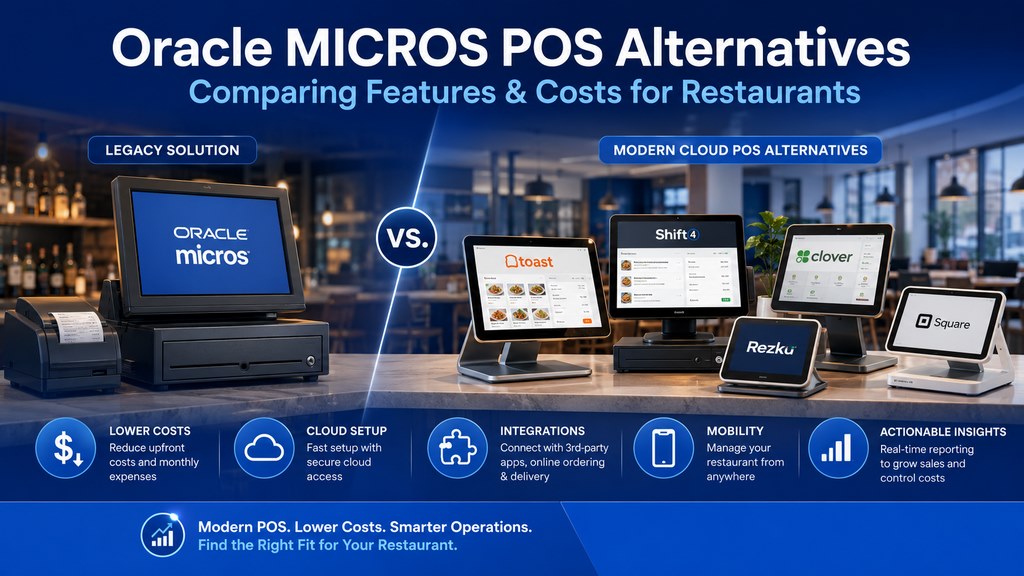
This guide covers the five most viable MICROS alternatives in 2026: Toast, SkyTab, Clover, Square for Restaurants, and Rezku.
Cloud vs. Legacy POS: Why Restaurants Are Migrating from MICROS
Disclaimer: Information in this section is general in nature and does not substitute for professional consultation regarding your specific operational and financial circumstances.
Modern POS systems now match or exceed legacy MICROS in core restaurant functionality — at 30–60% lower total cost of ownership for most non-enterprise operators. The migration case rests on four structural differences.
Infrastructure dependency. MICROS runs on a local application server. If it fails, the POS fails. MICROS tech support recovery windows range from 2 to 8 hours depending on technician availability. Cloud systems distribute processing across redundant data centers, eliminating that single point of failure.
Licensing and maintenance cost. Legacy MICROS carries perpetual license fees of $5,000–$20,000 per installation plus approximately 20% annual maintenance — NCR documentation, ncrvoyix.com/pos-legacy, 2022. MICROS pricing reflects this capital-heavy model. Cloud POS subscriptions run $50–$165/month per terminal, converting capex to predictable opex.
According to NCR, annual maintenance costs account for approximately 20% of the license fee.” — NCR documentation, 2022. ncrvoyix.com/pos-legacy
Scalability. Adding a MICROS location requires hardware procurement, server configuration, and on-site installation — typically 2–6 weeks. Cloud systems provision new locations through software configuration. Toast handles 1M+ orders per day across 100,000+ locations via auto-scaling infrastructure — Lightspeed Commerce analysis, lightspeedhq.com/pos-comparison, 2023.
Integration access. MICROS integrations are available but expensive to build and maintain. Square’s developer platform (developers.squareup.com, 2024) and Toast’s developer portal (pub.toasttab.com, 2023) both support ERP, CRM, delivery platforms, loyalty programs, inventory management, and labor scheduling — the ten integration categories most demanded by growing restaurant brands, per PYMNTS POS Report Q4 2024 (pymnts.com).
The Square and Toast platforms support ERP, CRM, delivery platforms, loyalty programs, inventory management, and staff scheduling.” — PYMNTS POS Report Q4 2024. pymnts.com
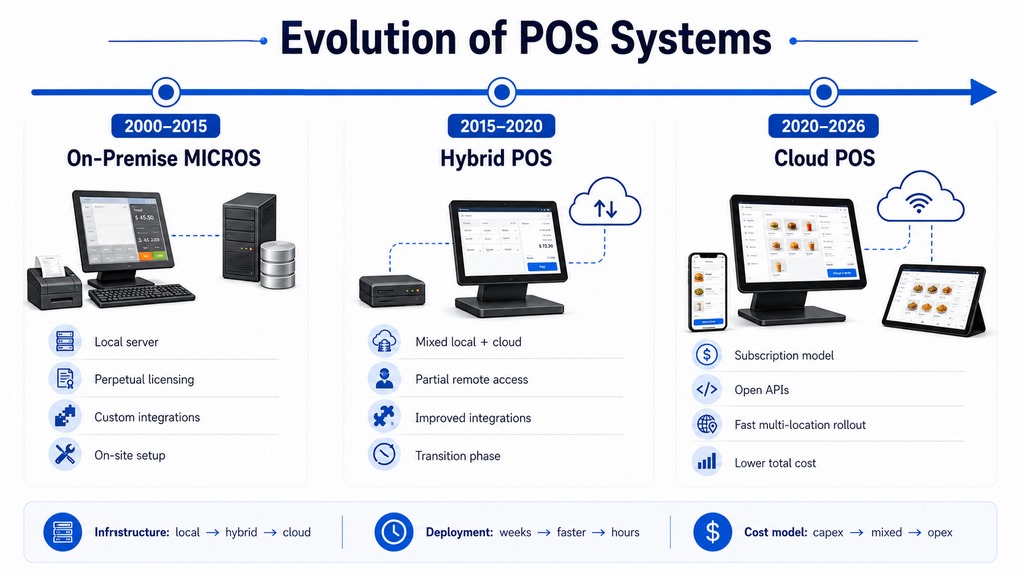
| Parameter | Legacy MICROS | Cloud POS | Operational Impact |
|---|---|---|---|
| Architecture | Monolithic client-server, local SQL | Microservices/SaaS on AWS/Azure | Cloud: no single hardware point of failure |
| Offline Mode | Full (server-dependent) | 4–24 hours cached, auto-sync | MICROS requires local server running |
| Scalability | Vertical, up to ~10 locations | Horizontal, 1,000+ via API | Cloud: new location in hours vs. weeks |
| Integrations | Limited, custom-built, expensive | Open API, 300–500+ native | Cloud: delivery, loyalty, accounting without custom dev |
| Pricing Model | Perpetual license + 20% maintenance | Subscription $50–$300/month | MICROS: high capex; Cloud: predictable opex |
Restaurant POS Systems Comparison
POS terminals and workstations vary significantly across formats. No single alternative dominates all restaurant types — the right system depends on transaction volume, service model, location count, and IT support capacity.
| System | Architecture | Offline Support | Native Integrations | Starting Price | Best For |
|---|---|---|---|---|---|
| Oracle MICROS | On-premise, local server | Full (server-dependent) | Limited, custom-built | $5,000–$20,000 license + 20% maintenance | Enterprise multi-property, hotels |
| Toast | Cloud (AWS) | Up to 4 hours | 300+ | $0–$165/month + processing | Full-service restaurants, multi-location chains |
| SkyTab (Shift4) | Cloud | Reliable auto-sync | Strong core set | Custom (Shift4 processing) | High-volume bars, clubs, large restaurants |
| Clover (Fiserv) | Cloud | Partial | 500+ (App Market) | $14.95–$54.95/month + 2.3% + $0.10/txn | Cafes, QSR, small-to-mid |
| Square for Restaurants | Cloud | ~30 minutes | Delivery-focused | $0/month + 2.6% + $0.30/txn | Food trucks, QSR, single locations |
| Rezku | Cloud | Reliable | Moderate | Custom | Independent full-service operators |
The 5 Best POS Alternatives to Oracle MICROS
1. Toast POS: Best Overall for Full-Service Restaurants
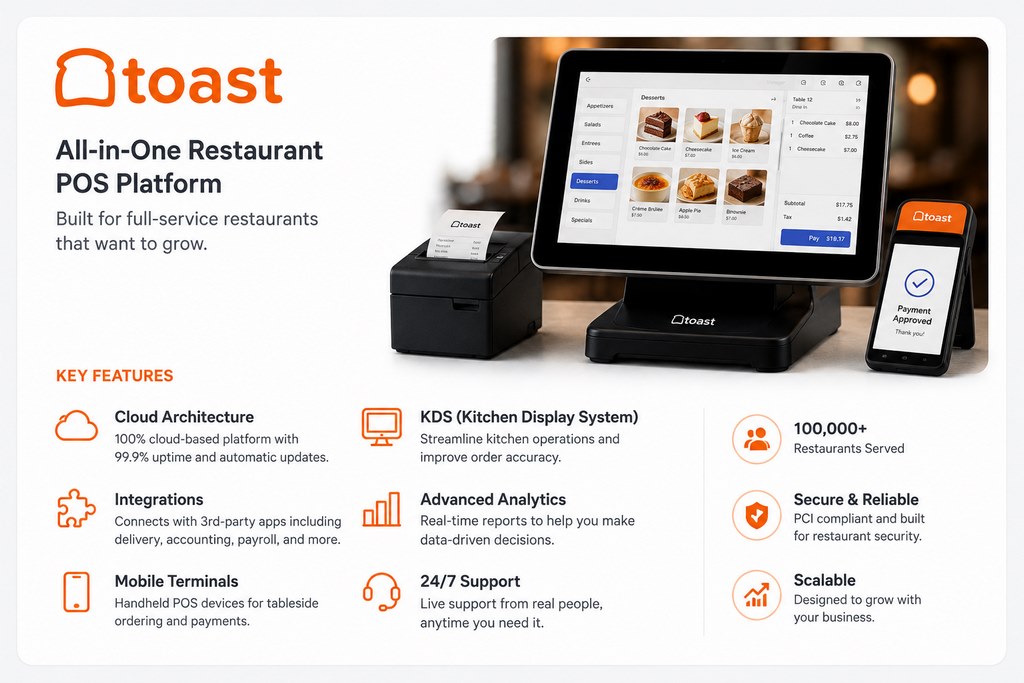
Toast is the strongest direct replacement for MICROS in full-service environments. It covers the core MICROS use cases — table management, KDS, tableside ordering, multi-location reporting — without the infrastructure overhead.
MICROS restaurant POS operators evaluating Toast will find the closest feature parity of any cloud system reviewed here.
What it does well. Toast runs on AWS with redundant architecture. The KDS integrates natively without middleware. The developer portal (pub.toasttab.com) documents 300+ integrations including DoorDash, Uber Eats, Grubhub, QuickBooks, Xero, and Deputy for labor management. Offline mode maintains transaction processing for up to 4 hours and syncs automatically on reconnect.
The Toast developer portal documents over 300 integrations, including DoorDash, Uber Eats, Grubhub, QuickBooks, Xero, and Deputy.” — Toast developer portal, 2023. pub.toasttab.com
Where it falls short. Multi-location management works well up to ~50–100 locations; above that, reporting hierarchy and role-based access controls are less granular than MICROS enterprise configuration. Hardware is proprietary — Toast-certified terminals only.
Pricing. $0–$165/month per location. Hardware: $300–$800 for tablet setups.
Ideal for: Full-service restaurants with 50–500+ seats, emerging multi-location groups, operations with active delivery integration. Toast covers the full-service feature set with a mature integration ecosystem.
2. SkyTab (Shift4): Best for High-Volume Establishments
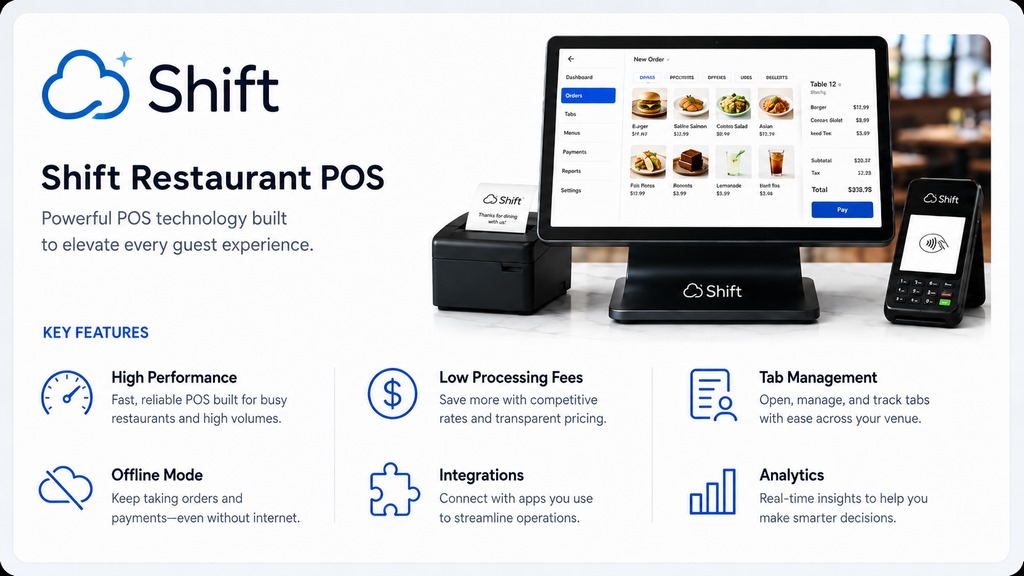
SkyTab is built by Shift4, a payment processing platform — which means payment infrastructure is native to the system, not bolted on. For high-volume operations where transaction speed and processing reliability matter most, this architecture has real advantages.
What it does well. The Shift4 payment layer eliminates middleware latency that affects some third-party integrations. For bars and nightclubs running high transaction density across multiple simultaneous tabs, the system handles peak load reliably. Offline mode syncs automatically. Tab management supports pre-authorization workflows.
Where it falls short. The integration ecosystem is narrower than Toast’s. The system is tied to Shift4 for payment processing — you’re not choosing your processor independently.
Pricing. Quote-based, bundled with Shift4 processing. Rates start at ~1.99% for qualified transactions; actual rates depend on volume and business type.
SkyTab POS has been a heaven sent system for us. The system itself is so user friendly and their staff made the conversion so seamless. They have 24-hour customer service so you have access to getting any issues resolved at any time of the day 7 days a week.” — Operator supported by Max Artemenko, MICROS Integrated Payments
That 24/7 support access is operationally significant. It’s what distinguishes a system you can run with a small team from one that requires dedicated IT.
Ideal for: Bars, nightclubs, high-volume restaurants, multi-location groups where processing volume creates leverage on Shift4 rates. Learn more about payment processing for restaurants.
3. Clover POS: Best for Small to Mid-Sized Cafes and Quick Service
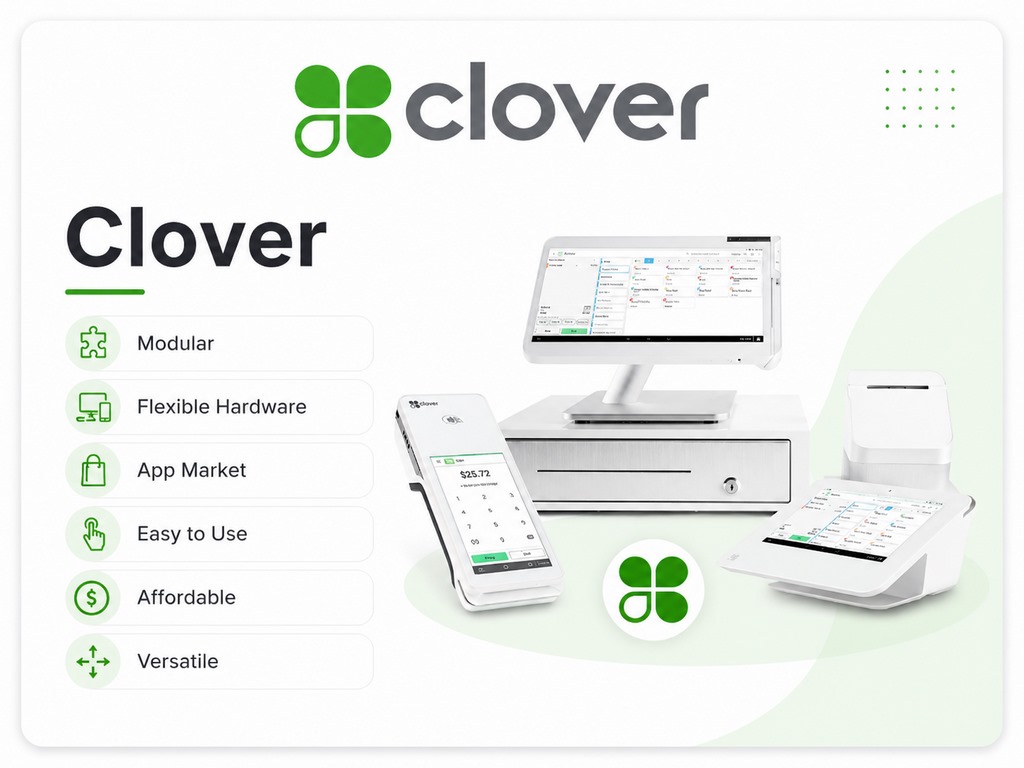
Clover (Fiserv) takes a modular approach: broad hardware ecosystem, 500+ App Market applications, and the lowest entry price of the systems reviewed here. The tradeoff is that full-service functionality requires assembling the right app combination — it’s not pre-configured out of the box.
What it does well. Hardware covers every format: Station Duo (14″ HD display, Intel Celeron, 4GB RAM, integrated receipt printer, $1,499) for counter service; Flex (8″ Gorilla Glass touchscreen, 2.6GHz quad-core ARM, 4G/LTE/WiFi/Bluetooth, EMV/NFC/tap, ~58-hour battery, $499) for mobile and tableside use — Clover product documentation, clover.com/flex, 2024. The App Market (developer.clover.com, 2025) extends the system into inventory, loyalty, and analytics without custom development.
The Clover Flex, featuring an 8-inch touchscreen, 4G/LTE/WiFi/Bluetooth, and EMV/NFC/tap, costs $499.” — Clover product documentation, 2024. clover.com/flex
Where it falls short. Multi-location management is functional but not enterprise-scale. The modular app approach adds monthly costs per app — the base subscription ($14.95–$54.95/month plus 2.3% + $0.10 per card transaction, clover.com/pricing, 2023–2025) doesn’t include everything a full-service restaurant needs. Support is primarily chat and FAQ.
Clover’s basic subscription costs $14.95–$54.95 per month, plus 2.3% + $0.10 per card transaction.” — clover.com/pricing, 2023–2025. clover.com/pricing
Pricing. Starter: $14.95/month + 2.3% + $0.10/txn. Hardware: $499 (Flex) to $1,499 (Station Duo). Browse POS terminals for hardware comparisons.
Ideal for: Cafes, bakeries, QSR, single-location retail, operators who want hardware flexibility and low entry cost.
4. Square for Restaurants: Best for Quick Service and Emerging Brands
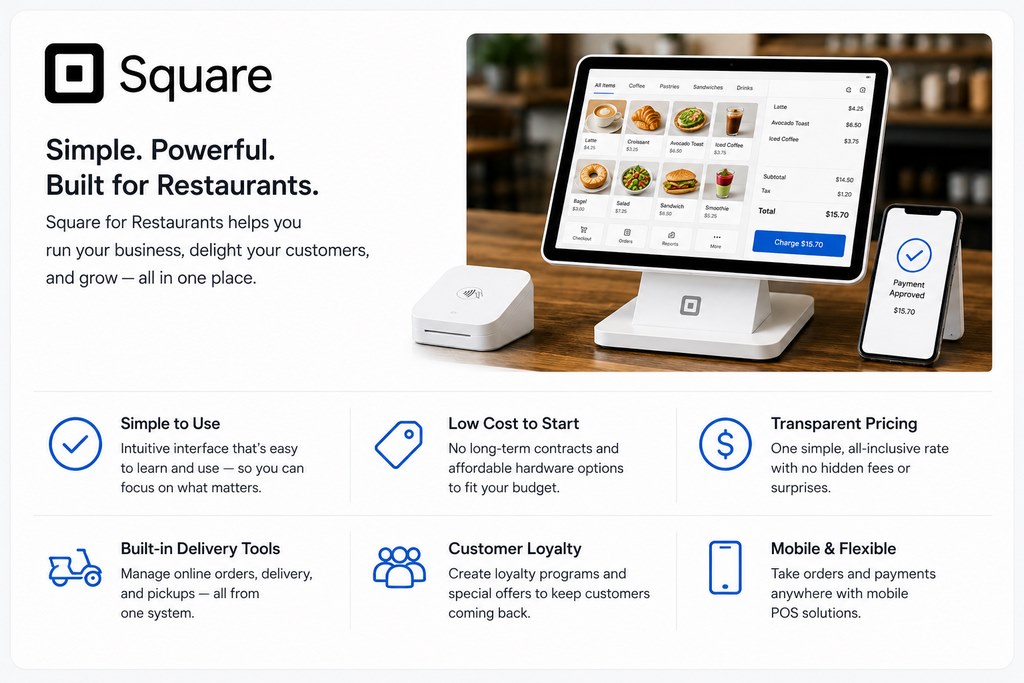
Square is the lowest-friction entry point in this comparison. No hardware lock-in beyond the reader, no monthly fee on the base plan, transparent processing rates. For an operator launching a first location or running a food truck, that simplicity has genuine value.
What it does well. The free tier includes basic POS functionality at 2.6% + $0.30 per card-present transaction. Delivery integrations with DoorDash and Uber Eats are native. Staff can operate the interface competently within an hour. Loyalty and marketing tools are built in.
Where it falls short. Offline window is ~30 minutes — shortest in this comparison. No native table management for full-service environments. Multi-location reporting lacks depth for growing groups. Inventory management is basic.
Pricing. Free plan: $0/month + 2.6% + $0.30/txn. Plus plan: $60/month per location. Hardware: iPad-based setup $300–$800. An online ordering terminal setup with Square requires minimal upfront investment — it runs on a single iPad with a card reader.
Ideal for: Food trucks, QSR, coffee shops, single-location emerging brands.
5. Rezku: Best for Independent Operators Seeking Personalized Support
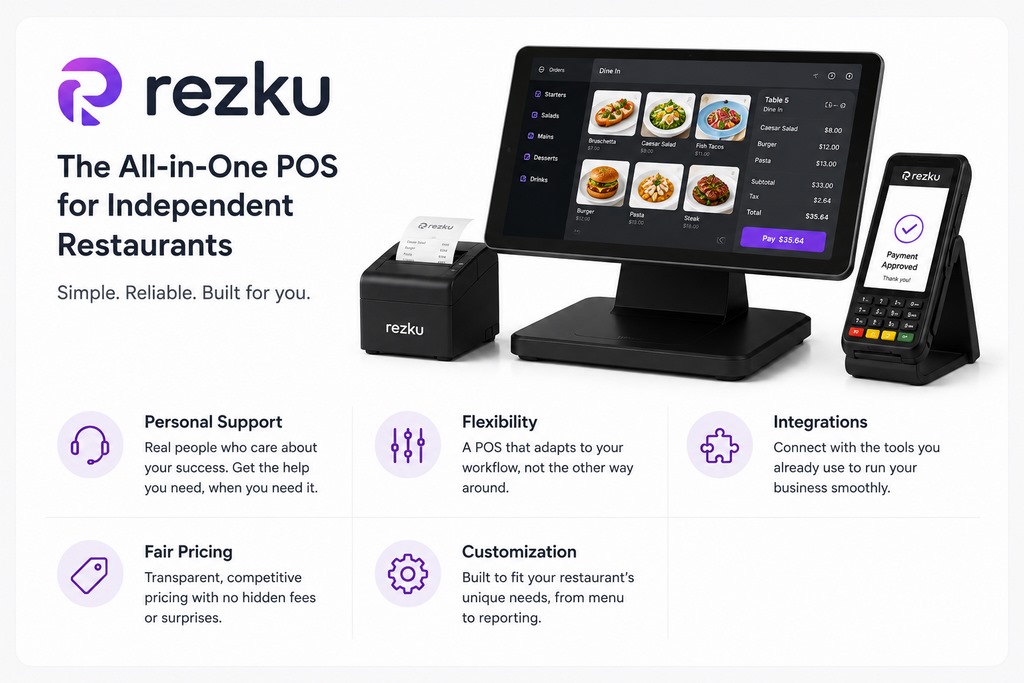
Rezku occupies a specific niche: independent full-service operators who need a capable cloud POS with direct, personalized support rather than a ticket queue. MICROS restaurant POS operators moving to Rezku typically cite support responsiveness as the deciding factor.
What it does well. Each client gets an assigned account manager — not a support tier, an actual person. For an independent gastropub without dedicated IT staff, that relationship has real operational value. The system is customizable to specific workflow requirements without enterprise pricing. Delivery, loyalty, and marketing integrations are available.
Where it falls short. Integration ecosystem is smaller than Toast’s or Clover’s. Interface is functional but less polished. For networks above 5–10 locations, the support model doesn’t scale as efficiently as Toast’s or SkyTab’s enterprise tiers.
Pricing. Quote-based. Verify specifics directly with Rezku’s sales team.
Ideal for: Independent full-service restaurants, gastropubs, specialty operators who prioritize support responsiveness over feature breadth.
“The shift from a legacy on-premise POS to a cloud system isn’t just a technology upgrade — it’s a change in how you think about your operational infrastructure. The operators who do it well treat it as a systems project, not a software purchase.” — Max Artemenko, MICROS Integrated Payments
Essential Features for Restaurant Workflow Optimization
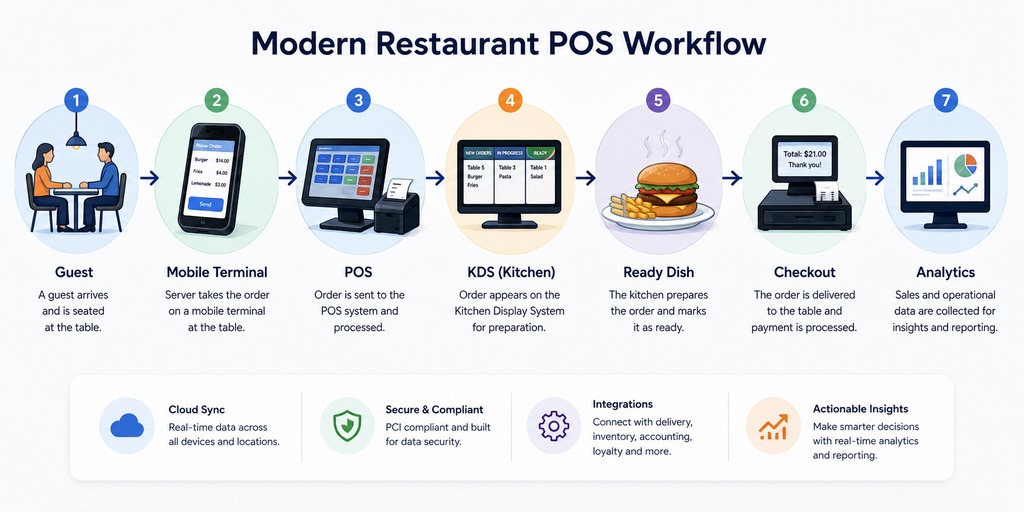
Modern MICROS alternatives cover the core workflow requirements that made MICROS the enterprise standard — and add integration layers that legacy architecture couldn’t support without custom development.
Kitchen Display System (KDS). Orders route directly from the POS to kitchen display systems, segmented by station. This eliminates paper tickets and gives managers real-time visibility into ticket times. Toast and SkyTab include native KDS without middleware; Clover and Square support KDS through integrations.
Tableside ordering. Servers take orders on wireless handheld terminals; orders route directly to the KDS. In high-volume full-service environments, this directly affects table turn time. SkyTab’s handheld is particularly well-regarded for bar tab management.
Delivery platform integration. Toast and Square have the strongest native delivery integrations — DoorDash, Uber Eats, and Grubhub orders flow directly into the POS and route to the KDS without a tablet aggregator. Separate tablets for each delivery platform create errors and slow kitchen coordination. Yes, that’s as painful as it sounds.
Labor and staff management. Toast, SkyTab, and Clover all integrate with labor scheduling and time-tracking platforms. MICROS requires separate software for this function.
Loyalty programs. Built-in loyalty tools are available in Toast, Square, and Clover. MICROS gift cards and loyalty programs in legacy systems require third-party integration.
POS Scalability and Third-Party Integrations for Growing Brands
Cloud POS systems scale horizontally — adding locations is a configuration task, not a hardware project. Oracle MICROS POS operators expanding beyond 5–10 locations consistently cite this as the primary migration driver.
Multi-location management. Toast and SkyTab provide centralized dashboards for network-wide reporting, menu management, and pricing control. A menu change propagates to all locations simultaneously — in MICROS, this requires touching each installation individually.
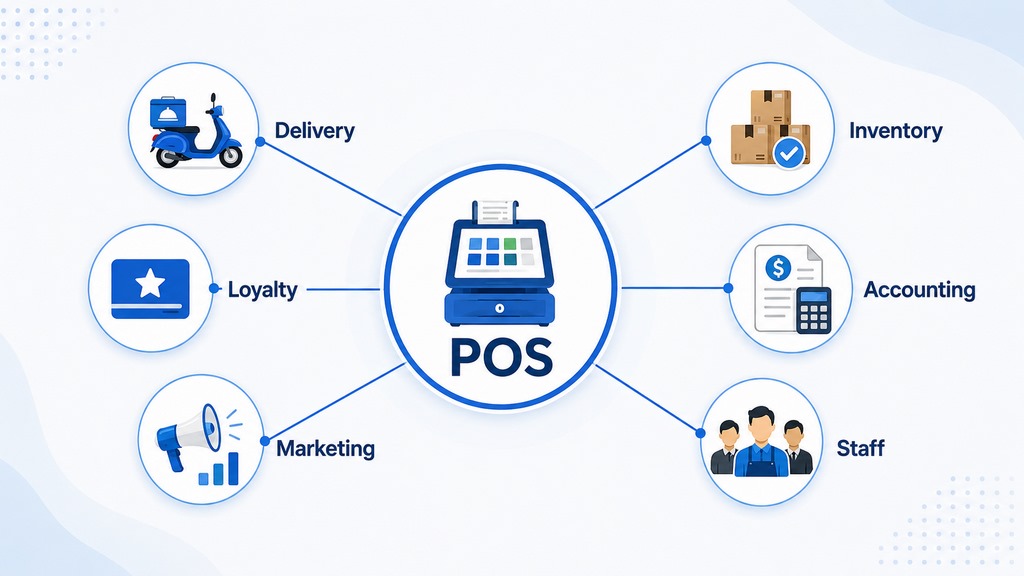
The integration ecosystem. The ten most demanded API integration categories for growing restaurant brands (per Square API docs, developers.squareup.com, 2024; Toast developer portal, pub.toasttab.com, 2023; PYMNTS POS Report Q4 2024, pymnts.com):
The ten most in-demand API integration categories for growing restaurant brands include delivery platforms, payment gateways, and loyalty programs.” — PYMNTS POS Report Q4 2024. pymnts.com
- Delivery platforms (DoorDash, Uber Eats, Grubhub) — 45% adoption
- Payment gateways — 38% adoption
- Loyalty programs — 32% adoption
- Online ordering platforms
- Kitchen display systems
- Inventory management (MarginEdge, Toast Inventory)
- Labor management (Deputy, Toast Labor)
- Accounting (QuickBooks, Xero)
- CRM and marketing (Mailchimp, HubSpot)
- ERP systems (NetSuite, Sage Intacct)
Hardware flexibility. Cloud systems run on iPad, Android tablets, or dedicated terminals — you’re not locked into a single hardware vendor at $2,000–$5,000 per terminal. See the Oracle MICROS tablet for legacy hardware context. Clover’s Flex at $499 and a standard iPad at $300–$400 cover the majority of use cases.
Restaurant POS Pricing Comparison
The cost gap between MICROS and cloud alternatives is real — but the full picture requires total cost of ownership (TCO), not just subscription fees. MICROS POS pricing reflects a fundamentally different cost model than cloud subscriptions.
| System | Monthly Subscription | Processing Fees | Hardware (per terminal) | Estimated Annual TCO (1 location) |
|---|---|---|---|---|
| Oracle MICROS Legacy | $400–$1,600 (maintenance) | 2.5–3.5% | $2,000–$5,000 | $15,000–$40,000+ |
| Toast | $0–$165 | 2.49–3.09% | $300–$800 | $5,000–$15,000 |
| SkyTab (Shift4) | Bundled with processing | From ~1.99% | $300–$800 | $4,000–$12,000 |
| Clover | $14.95–$54.95 | 2.3% + $0.10/txn | $499–$1,499 | $4,000–$10,000 |
| Square | $0–$60 | 2.6% + $0.30/txn | $300–$800 | $3,000–$9,000 |
| Rezku | Custom | Custom | $300–$800 | $4,000–$12,000 |
Licensing fees. MICROS perpetual licenses run $5,000–$20,000 per installation plus approximately 20% annual maintenance — NCR documentation, ncrvoyix.com/pos-legacy, 2022. Cloud systems eliminate the perpetual license entirely.
MICROS perpetual licenses cost between $5,000 and $20,000 per installation, plus approximately 20% for annual maintenance.” — NCR documentation, 2022. ncrvoyix.com/pos-legacy
Processing fees. A restaurant doing $1M in annual card volume at 3% processing pays $30,000/year. At 2.0%, that’s $20,000. The $10,000 difference funds the entire cloud POS subscription with room to spare. Fees eat margin — that’s the whole story.
MICROS often requires a specific processor, limiting rate negotiation. Cloud systems offer more flexibility — though Square and SkyTab/Shift4 have tighter processor constraints than others.
Hardware costs. MICROS proprietary terminals: $2,000–$5,000 per unit. Toast, Clover, and Square run on tablets in the $300–$800 range. For a 5-terminal installation, the hardware gap alone is $8,500–$21,000.
Calculating Your Restaurant POS Migration Costs
Migration from MICROS is a project, not a purchase. See Oracle MICROS POS installation and setup for a detailed process overview. Budget planning should cover five categories:
- Hardware replacement: $2,000–$10,000 depending on location size and terminal count
- Data migration: $0–$5,000 (menu database, customer records, historical sales)
- Staff training: $500–$3,000
- System configuration and integrations: $1,000–$5,000
- Downtime cost: A 100-seat restaurant doing $8,000/day loses that revenue per day of downtime — plan migration during slowest service periods
Total migration budget: $5,000–$20,000 for a single location. Recovery timeline through reduced processing fees and lower licensing costs: typically 6–12 months at mid-volume operations.
Here’s a real number from a migration I managed: the operator was paying $3,200/month in MICROS maintenance and processing costs combined. After moving to SkyTab with renegotiated processing rates, that dropped to $1,400/month — $21,600/year in savings. Migration cost $11,000. Payback was under 7 months.
How to Choose the Right POS for Your Business Type
MICROS restaurant POS operators should match the system to operational requirements before signing anything. No single alternative dominates across all restaurant formats.
For Full-Service Restaurants (50+ Seats)
Recommended: Toast or SkyTab. Toast covers table management, KDS, tableside ordering, and multi-location reporting with a mature integration ecosystem. SkyTab is better if processing volume creates leverage on Shift4 rates or if the operation runs a high-volume bar.
For Quick Service (Cafes, Bakeries, Fast Casual)
Recommended: Clover or Square. Clover’s hardware flexibility and App Market cover QSR requirements at lower TCO than Toast. Square is right when startup cost is the primary constraint.
For Bars and Nightclubs
Recommended: SkyTab or Toast. SkyTab’s tab management and processing infrastructure handle high-volume bar environments reliably. Learn more about payment processing for restaurants.
For Independent Full-Service Operators
Recommended: Rezku or Toast. Rezku’s account manager model provides direct support access without dedicated IT staff. Toast is better if integration breadth matters.
For Food Trucks and Mobile Operations
Recommended: Square or Clover Flex. Square runs on a single iPad with a card reader. Clover Flex is purpose-built for mobile — 4G/LTE, 58-hour battery, EMV/NFC/tap. Compare with the MICROS 721P Mobile POS Workstation for legacy context.
Common Migration Mistakes to Avoid
Most MICROS migration failures come from the same six operational errors. See Oracle MICROS POS installation and setup for a detailed process guide.
- Insufficient pre-launch testing. Go live without testing every menu item, modifier, discount, and integration under realistic conditions and you’ll face price errors on opening night. Run a full simulation during a soft-open or deliberately slow service period.
- Incomplete data migration. Verify data integrity before and after migration — item by item, modifier by modifier. If the new system offers a migration service, use it.
- Undertrained staff. A system that takes 30 minutes to learn still requires 30 minutes of actual hands-on time per employee. Schedule training 1–2 weeks before launch; designate power users who support colleagues on day one.
- No rollback plan. Keep MICROS operational and backed up for 1–2 weeks post-migration. Don’t decommission the old system until the new one is fully stable.
- Ignored integration dependencies. Map every integration before migration day and test each one independently. The delivery tablet, loyalty sync, and accounting export all need verification before go-live.
- Wrong system for the operation. Choosing Square for a 120-seat full-service restaurant because the price is right — then discovering it doesn’t support table management — is an expensive mistake. I’ve seen it happen.
Checklist for a Seamless Transition from Legacy to Cloud POS
3 months before: See Oracle MICROS POS installation and setup for full setup guidance.
- Select new POS system and sign contract
- Audit current MICROS data: menu structure, modifiers, pricing, customer records, historical sales
- Map all required integrations (delivery, loyalty, accounting, labor)
- Order hardware — terminals, tablets, printers, KDS screens
- Assign project manager
1 month before:
- Train key staff and power users
- Configure new system on test environment
- Import MICROS data and verify accuracy
- Connect and test all integrations
- Create full backup of MICROS data
1 week before:
- Run full system test under simulated service conditions
- Complete final staff training
- Confirm rollback plan: MICROS stays operational for 2 weeks post-launch
- Notify delivery platforms and loyalty program of system change
- Verify all payment processing credentials are live
Migration day:
- Choose slowest service period (Tuesday lunch, not Friday dinner)
- Bring new system live; keep MICROS on standby
- Run final payment processing test before first guest
- Station power users at terminals for first service
- Monitor transaction logs, KDS routing, and integration feeds in real time
Post-migration:
- Collect staff feedback within 48 hours
- Verify data integrity: sales reports, inventory counts, labor records
- Decommission MICROS after 2-week stability window
- Review processing fees against projections — renegotiate if volume supports it
Future-Proofing Your Tech Stack: 2026 Trends in Restaurant POS
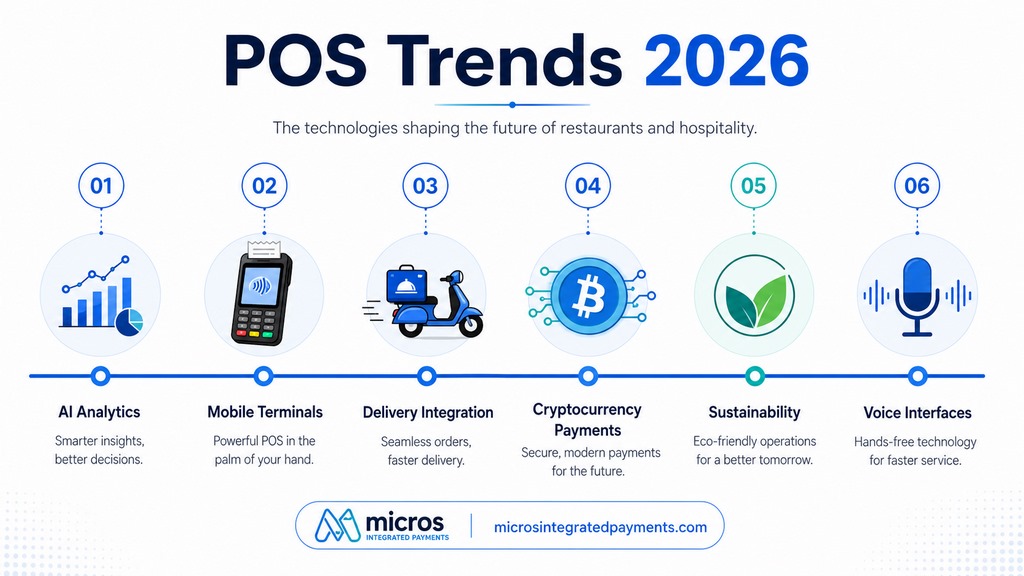
The POS market is moving faster than it did during the MICROS era. Review important POS system features for restaurants to evaluate which trends apply to your operation.
AI-driven analytics and predictive ordering. Systems are beginning to use machine learning for demand forecasting — predicting which items will sell based on weather, day-of-week, and historical patterns. Toast and Square have both announced AI analytics features; depth varies by plan.
Handheld-first architecture. Mobile terminals are becoming the primary interface in full-service environments. SkyTab’s handheld and Toast’s Go 2 are purpose-built for server-side use, not adapted from consumer tablets.
Unified delivery management. The aggregator tablet problem — separate screens for DoorDash, Uber Eats, and Grubhub — is being solved at the POS layer. Systems with native multi-platform delivery integration route all orders through a single interface.
Blockchain and cryptocurrency payments. A small but growing segment of urban operators is accepting crypto. Toast and Square have begun exploring this; it’s not mainstream infrastructure yet.
Sustainability and ESG reporting. POS systems are being extended to track food waste, packaging usage, and carbon footprint per transaction — relevant for operators in markets with ESG reporting requirements.
Voice-activated ordering. Voice interfaces are being tested for drive-through and kiosk environments. Full-service integration is further out.
Final Verdict: Which MICROS Alternative Is Right for You?
The right system depends on your format, volume, and operational constraints. Start with a cost audit — what you’re paying now in licensing, maintenance, and processing fees versus what a cloud system would cost at your actual transaction volume.
Choose Toast for full-service restaurants with 50+ seats, deep delivery integration needs, and multi-location reporting requirements.
Choose SkyTab for high-volume bars, nightclubs, or large restaurants where transaction throughput matters and processing volume creates leverage on Shift4 rates.
Choose Clover for cafes, bakeries, or QSR where hardware flexibility and low entry cost are priorities.
Choose Square for food trucks, coffee shops, or first-location launches where startup cost is the primary constraint.
Choose Rezku for independent operators who need a capable cloud POS and value direct, personalized support over feature breadth.
The migration math is consistent. Operators paying MICROS-era licensing and maintenance — typically $400–$1,600/month — plus above-market processing rates are carrying overhead that cloud systems eliminate. Migration investment ($5,000–$20,000 for a single location) pays back in 6–12 months at mid-volume operations.
MICROS remains the right answer for large hotel properties, casino operations, and enterprise restaurant groups with dedicated IT infrastructure and complex multi-property configurations. See MICROS Hotel Management System Software for enterprise use cases. For everyone else, the cost-benefit analysis has shifted.
About the Author: Max Artemenko is an Enterprise POS Expert & Systems Architect with 12+ years of experience implementing and stabilizing Oracle MICROS POS systems across restaurants, hotels, and multi-location networks in the US. He leads MICROS Integrated Payments, a project of Smart Payment Solutions (USA), focused on payment integration architecture for Oracle MICROS environments.
FAQ
Frequently Asked Questions
Is cloud POS as reliable as legacy MICROS?
For most restaurant formats, yes — and in some failure modes, more reliable. Cloud systems distribute processing across redundant data centers with 99.9% uptime SLA. MICROS depends on a local server: if it fails, the POS fails. Cloud offline modes (4–8 hours for Toast and SkyTab; ~30 minutes for Square) handle internet outages without server dependency. See our FAQ
How long does migration from MICROS take?
Single location with 1 terminal: 1–2 days. Mid-size with 3–5 terminals: 3–5 days. Large location with 10+ terminals: 1–2 weeks. Multi-location network (10+ sites): 1–3 months with staged rollout. See MICROS POS installation and setup.
Which alternative handles complex kitchen workflows best?
Toast and SkyTab have the most developed native KDS implementations — multi-station routing, order priority management, allergen and modification flagging. Rezku is strong for independent operators with specific workflow requirements. See kitchen display systems for MICROS.
Can I keep my current payment processor when switching?
Depends on the system. Toast supports 50+ processors. Clover supports 30+. SkyTab requires Shift4. Square is Square Payments only. Rezku supports 20+. Verify compatibility before committing. See payment processing for restaurants.
What's the most affordable option for a single-location restaurant?
Square’s free plan has zero monthly software cost — 2.6% + $0.30 per card-present transaction. For $500K/year in card volume, that’s $13,000–$14,500 in annual processing fees. Clover’s Starter at $14.95/month plus 2.3% + $0.10/txn may be more cost-effective at higher volumes. MICROS POS pricing.
What hidden costs should I budget for?
Processing fees (1.99–3.5% of card volume — the largest ongoing cost), hardware ($300–$1,500 per terminal), monthly subscription ($0–$165/location), integration fees ($0–$200/month per integration), training ($0–$3,000), and migration labor ($0–$5,000). Request a complete TCO breakdown from any vendor before signing. See credit card processing fees.
How does cloud POS handle multi-location management?
Centralized menu management (change prices across all locations simultaneously), consolidated network-wide reporting, role-based access control by location, and centralized labor management. Toast and SkyTab have the most developed multi-location architectures.
Which system integrates best with delivery platforms?
Toast and Square have the strongest native delivery integrations — DoorDash, Uber Eats, and Grubhub orders flow directly into the POS and route to the KDS. Clover and Rezku support delivery through App Market or third-party middleware. See integrated online ordering for MICROS.