
Pricing data current as of Q2 2026. Always confirm final figures directly with Oracle or your payment processor before signing.
Quick Answer: TL;DR
Choose Oracle MICROS Simphony if your operation is large, tied to hotel PMS infrastructure (especially OPERA), manages multiple concepts under one umbrella, or needs deep centralized control and processor flexibility.
Choose Toast if you need faster rollout, simpler staff onboarding, and a restaurant-first cloud setup — and hotel-grade integrations are not part of your stack.
Consider Shift4 Dine (formerly SkyTab POS) if you want practical restaurant workflows with close payment-operations alignment and less enterprise overhead.
If you are currently running an old MICROS RES 3700, there is a strong chance the real question you are asking is not "Toast vs MICROS Simphony" — it is "what do I replace my dying terminal with?" That context changes the whole analysis. More on that below.
Who Is Comparing These Systems — and Why
Choosing between Oracle MICROS vs Toast usually comes down to one thing: are you buying for a straightforward restaurant rollout, or for a more complex hospitality operation with layers of integrations, controls, and long-term processor strategy?
"When operators compare Toast vs MICROS, the mistake is treating both systems as if they were built for the same job. In my experience, Toast wins on simplicity for many independents. MICROS Simphony wins when the business is operationally heavier, more integrated, or harder to standardize across locations." — Max Artemenko, POS Systems Expert & Product Architect, Micros Integrated Payments
The clean directional signal from industry comparison sources is consistent: Oracle MICROS Simphony is positioned for enterprise hospitality, hotels, stadiums, and venue environments, while Toast is positioned as a restaurant-first cloud POS for independent operators and growing chains. Sources include Capterra's comparison page, SourceForge's product comparison, and Restroworks:
So this article answers the real operator question. Not the demo question.
The Legacy MICROS Problem: RES 3700 and Windows 10 EOL
Many operators searching "Oracle MICROS vs Toast" are not actually comparing two current cloud systems. They are trying to figure out what to do with an aging RES 3700 terminal that is starting to feel like a liability.
Here is what happened. Oracle bought MICROS Systems in 2014 for approximately $5.3 billion and folded the brand into its Oracle Hospitality and Food & Beverage business unit. All of Oracle's restaurant development effort now goes into Simphony, its cloud platform. The RES 3700 — the grey terminal sitting in hundreds of thousands of restaurants that opened before 2010 — is no longer sold by Oracle. Oracle still provides what it calls "sustaining support": existing fixes are available, but no new patches and no new security certifications are being built.
Your terminal is not about to break. The problem is what it can no longer join.
In the years since the Oracle acquisition, restaurant technology rebuilt itself around the cloud. Online ordering, delivery apps, loyalty programs, QR menus, waitlist tools: every new way a guest can hand you money now ships as software that plugs into a cloud POS. Open the integrations page of any modern restaurant tool and you will find Toast, Square, and Clover listed. Look for RES 3700. It is almost never there, and when it is, the connection runs through extra middleware with its own fee and its own ways to break on a Friday night.
That gap charges you in missed orders and double-typed tickets. A side tablet where staff manually re-enter orders into the till during the rush is not a free solution — it is an error-prone workaround with a hidden cost.
Two hard dates make this more urgent. Microsoft ended Windows 10 support on October 14, 2025, and many older MICROS setups run on Windows 10. Keeping a Windows 10-based terminal means workarounds at PCI audit time and a shrinking pool of refurbished spare parts. When a board fails mid-service, you are hunting for used components.
The practical exercise: list the revenue channels you are currently skipping or running on side tablets — online ordering, delivery integrations, loyalty, QR menus. Assign a monthly number to each. If that total is near zero, the old terminal still fits how you operate. In most cases, that total is not near zero, and it grows every year the ecosystem moves further away from your counter.
If your RES 3700 is the real trigger for this search, the comparison that follows will help you choose the right replacement.
Which Restaurants Fit Oracle MICROS vs Which Fit Toast
"Oracle MICROS Simphony is oriented toward large multi-property businesses and hotels, while Toast is positioned as a cloud POS system for restaurants." — Micros Integrated Payments, 2026
The difference is less about "which POS is better" and more about which operating model you are buying into. Toast POS is designed around restaurant simplicity and bundled workflows. Simphony Cloud is designed for broader hospitality complexity, multi-location management, and environments where centralized control matters more than quick setup.
Oracle MICROS vs Toast: Which POS fits your business format best
Business scenario Oracle MICROS / Simphony Toast POS Better fit
Independent full-service restaurant Strong, but may be more system than needed Simple deployment and easier onboarding Toast
Small growing restaurant group Capable, especially if governance matters early Usually easier and faster to implement Toast in many cases
Large restaurant group Strong centralized controls and enterprise structure Can work, but needs careful fit review MICROS
Hotels with food & beverage outlets Strong hospitality alignment, especially with OPERA PMS context Less natural fit for hotel PMS-heavy operations MICROS
Stadiums and venues Better known fit for complex venue operations Less proven in this context MICROS
Processor flexibility matters More room to evaluate integrations and processor strategy Greater risk of payment processing lock-in MICROS
Restaurant wants lowest-friction onboarding Heavier implementation path Cleaner learning curve for many operators Toast
Migrating from legacy RES 3700 (1–2 locations) Simphony is the natural Oracle path, but may be more than needed Faster, more affordable alternative Toast or Shift4 Dine
Oracle's own Simphony positioning highlights enterprise-style capabilities such as 200+ integrations, offline mode, and 24/7 support, which matters when the question is not only POS features but operating resilience and stack connectivity: Oracle Simphony POS.
When MICROS Simphony Is Stronger in Enterprise Scenarios
MICROS Simphony is stronger when the business has more than "restaurant POS" requirements. It is a better fit when the operation needs enterprise restaurant POS logic, multi-location management, hotel PMS integration (PMS = Property Management System), OPERA-related workflows, or venue-grade deployment structure.
This is where the Simphony vs Toast comparison stops being a UI discussion and becomes an infrastructure discussion.
From my experience, the tipping point usually appears when the operator says one of these things:
- "We have multiple concepts under one umbrella."
- "Corporate wants tighter centralized control."
- "We need to think about hotel PMS integration."
- "We cannot rebuild the whole payment and reporting stack from scratch."
- "Some sites behave more like venues than standard restaurants."
A real-world example. A multi-unit operator had solid restaurant volume but also layered approval paths, mixed service models, and external system dependencies. The first instinct was to simplify by replacing the stack with something more packaged. After mapping the real process dependencies, the risk shifted from "complex MICROS" to "oversimplified replacement," and the operator stayed with a Simphony modernization path instead of forcing a migration.
That result is common. Complexity does not disappear because the demo feels easier.
When Toast Is More Convenient for Independent Restaurants and Growing Groups
Toast is usually easier for independent restaurants and many growing groups because the system is restaurant-first, more standardized, and simpler to train around. While Simphony Essentials starts around $55/month per terminal, Toast often leads with a $0/month starter kit tied to higher payment processing rates. Always model the processing fees over 3 years before deciding which starting price is actually lower.
In practice, Toast makes sense when:
- the restaurant group is still standardizing operations;
- corporate governance is lighter;
- hotel PMS integration is not a core requirement;
- the operator prefers an all-in-one buying motion;
- speed of deployment matters more than processor optionality.
There is a reason Toast sales teams get traction with MICROS operators. They lead with fewer moving parts. For some businesses, that is exactly the right answer. For others, it becomes a constraint later.
Architecture, Interface, and Daily Staff Experience
Toast usually feels easier at first touch. MICROS usually gives more structural depth once the environment gets more complex.
While vendors rarely publish head-to-head speed tests, in real-world rush hours, Toast's opinionated UI often leads to faster onboarding, whereas Simphony requires more upfront admin discipline to configure correctly. That tradeoff matters differently depending on the size and complexity of the operation.
What matters operationally is not "which screen looks nicer." It is how the system behaves under actual shift pressure.
Interface and Learning Curve for Front-of-House and Managers
Toast generally has the lighter learning curve for frontline staff. MICROS often requires more setup discipline and admin understanding, but pays that back in more structured control for larger organizations.
Front-of-house teams feel the difference first. Toast tends to win the first-week reaction test because flows are more opinionated and restaurant-centered. With Simphony Cloud, the learning curve can be steeper because the system is being fitted to more operational scenarios rather than just one standard restaurant pattern.
From my experience, the better question is not "Which team learns faster on day one?" It is "Which team makes fewer costly process mistakes after month three?"
A short example. One operator focused heavily on fast staff adoption during vendor demos. After rollout analysis, the bigger issue was not button taps. It was permissions, exception handling, and reporting consistency across sites. The system that looked simpler in training created more downstream cleanup because the organization itself was not simple.
Yes, that part is less visible. It matters more.
Offline Mode and Kitchen Operations Without Disruptions
Offline resilience matters more in busy service than most buyers admit. Oracle explicitly states offline mode on Simphony product materials, and that is a meaningful operational point for restaurants, hotels, and venues where connectivity issues cannot stop order flow: Oracle Simphony POS.
For Toast, the platform supports offline functionality, including store-and-forward for card payments, but the behavior under degraded connectivity should be validated in your exact environment during demos and pilots rather than trusted based on marketing claims alone. The responsible approach is to test both systems against your real scenarios.
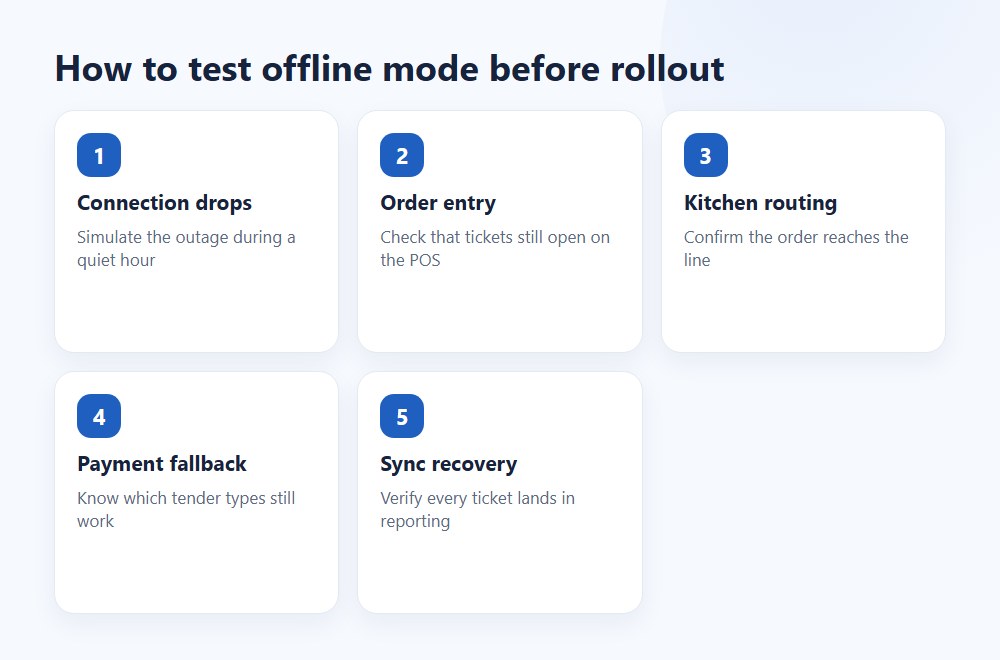
What should be tested before any rollout:
- order entry when connectivity degrades;
- kitchen display system continuity;
- payment fallback workflows (including store-and-forward card handling);
- manager overrides during network issues;
- sync behavior after recovery.
Multi-Location Management, Reporting, and Integrations
Both systems cover core restaurant POS functions. The bigger separation appears in centralized control, reporting structure, and integration fit with the rest of the business.
If the buying committee includes finance, IT, operations, and hospitality leadership, this section matters more than the home screen.
The consistent directional split: MICROS/Simphony is associated with complex hospitality integrations and enterprise control, while Toast is framed as a modern restaurant platform with a more packaged ecosystem: Restroworks comparison, Capterra comparison.
Multi-Location Management and Centralized Control
For large multi-location management, MICROS usually has the stronger case. For simpler groups that want standardization without heavy enterprise overhead, Toast may feel more efficient.
This is where the Toast vs Oracle MICROS comparison for large restaurant groups becomes a governance question.
Large groups care about:
- consistent menus across properties;
- role-based permissions;
- reporting by concept, property, and corporate layer;
- deployment control across many sites;
- exception handling and audit discipline.
Simphony Cloud has long been part of environments where those requirements are normal, not edge cases. Toast supports multi-unit growth too, but the fit depends on how much operational variation exists between locations and how much the business needs to connect beyond pure restaurant workflows.
A real-world example. A group with several locations wanted to unify reporting and reduce site-level workarounds. The first review focused on menus and terminals. The real blocker turned out to be centralized approval logic and cross-location consistency. Once those were prioritized, the system evaluation changed from "ease of use" to "control at scale." That changes the shortlist fast.
Integrations with External Systems and Corporate Stack
MICROS is usually stronger when external systems are part of the business model. That includes hotel PMS (Property Management System) integration, OPERA-related workflows, and cases where the operator wants more choice of payment processor rather than a closed default stack.
Oracle's Simphony page states 200+ integrations, which is an important signal for enterprise buyers evaluating system fit beyond POS screens: Oracle Simphony POS.
If the operation touches OPERA, hotel billing, room-charge behavior, or broader hospitality systems, MICROS is the more natural starting point. For those scenarios, see the dedicated resource on integrating MICROS with OPERA PMS. The hospitality stack fit is not the same question as "Does it connect to common restaurant apps?" This distinction gets missed constantly. If a restaurant group is really a hospitality group, integrations are not a side note — they are part of the operating model.
Total Cost of Ownership: Subscription, Hardware, Processing, Contracts
Disclaimer: Information about prices and tariffs is provided for reference purposes. Final costs depend on hardware configuration and payment processor terms. Always request a written quote before committing.
Toast often looks simpler at the starting line. MICROS often needs a more project-based TCO review because costs can sit in more places: edition, environment, integrations, support structure, payment model, and hardware path.
The right question is not "Which monthly fee is lower?" It is "Which total cost of ownership fits the next three years?"
Simphony pricing overview: Oracle does not publish one universal Simphony price for all editions — for detailed and current pricing options, see Oracle MICROS POS pricing and purchasing options. In Oracle's 2026 cloud price list, many Simphony items are marked N/A rather than a single public fixed price. Public-facing review sources commonly cite Simphony Essentials from $55/month per terminal and Simphony Plus from $75/month, with enterprise or single-tenant pricing quoted separately:
Toast pricing overview: While Simphony Essentials starts around $55/month, Toast often leads with a $0/month Starter Kit tied to higher payment processing rates. The economics only become clear when you model the blended processing fees over 3 years at your actual card mix and transaction volume.
How to compare total cost of ownership without invented numbers
Cost category Oracle MICROS / Simphony Toast POS What to verify
Software subscription Essentials: ~$55/terminal/mo; Plus: ~$75/mo; enterprise: quote-based Starter Kit from $0/mo; add-ons increase the bill Which modules are included at which tier
Hardware Oracle promotes $1/device migration offer on select hardware; Workstation 8 ~$1,800–$2,200 per unit (reseller pricing); tablet options available Hardware tied to Toast ecosystem Warranty, replacement, lifecycle
Payment processing Open processor strategy possible; reported card-present rates ~2.45% + $0.15, card-not-present ~2.99% + $0.18 Starter Kit requires Toast processing; verify lock-in terms Effective blended rate modeled over 3 years
Implementation Often project-based; installation ~$500–$2,595 depending on configuration Often simpler for standard restaurant rollouts Menu build, training, rollout scope
Integrations 200+ integrations; connector fees and middleware costs vary Also variable, but ecosystem approach differs Connector fees, middleware, custom work
Support 24/7 support messaging exists; contract scope varies; optional premier support ~15% of hardware net price/year Verify what post-launch support actually includes SLA, escalation, after-hours process
Contract terms Quote-based structure; metered components for transaction volume Contract and processor terms must be reviewed carefully Length, exit terms, add-ons
Note: Simphony enterprise single-tenant environments carry an additional environment fee (reported at ~$75,000 in one 2026 industry analysis). This applies only to large enterprise deployments and is not part of standard Essentials/Plus pricing.
Payment Processing Lock-In and Processor Choice
This is one of the biggest practical differences. Toast must be evaluated with its payment processing requirement in mind, while MICROS buyers often care more about preserving choice of payment processor through integrations and partner structure.
That affects long-term cost more than many operators expect.
Where a POS platform tightly couples software and processing, TCO is not just the subscription fee. It is the combined economics of software, hardware, processing, and contract terms over time.
For MICROS operators, this matters because many already know where margin gets lost. Not on the sales deck. On processing spread, add-on fees, and limited negotiation leverage. Fees eat margin quietly — and they do it every single transaction.
A practical example. An operator compared systems based on software simplicity first. During diligence, card mix, average ticket, and payment routing economics were modeled against the full contract path. The original "cheaper" option stopped looking cheaper once processing structure became visible.
This is the boring spreadsheet part. It is also where real money lives.
3-Year TCO model inputs to prepare:
- Number of terminals
- Monthly transaction volume and average ticket
- Card mix (credit, debit, AMEX)
- Selected software modules
- Implementation and training costs
- Integration fees
- Hardware replacement assumptions
"Planning to switch POS systems or upgrade your current setup? The Micros Integrated Payments team led by Max Artemenko can calculate your real total cost of ownership and ensure a seamless migration. We offer 24/7 support and the best processing rates for restaurant groups." — Micros Integrated Payments
Hardware Durability and Hidden Device Fleet Costs
Hardware durability matters more in restaurant and venue environments than in office software buying. A POS terminal that survives heat, spills, grease, impact, and nonstop service reduces not only replacement spend but also downtime and support friction.
Oracle publicly highlights restaurant hardware lines, including the Workstation 8 series and tablet lines, and promotes a $1 per device migration offer on some restaurant POS pages for eligible switching scenarios: Oracle restaurant POS hardware.
For Workstation 8 specifically:
- 14-inch FHD touchscreen, Intel Celeron J6413 quad-core, 8 GB RAM
- 128 GB SSD (Oracle Linux) or 256 GB SSD (Windows)
- Wi-Fi 6E optional, IP54-rated system unit
- Oracle publishes specs but not public MSRP; reseller and partner market references place units roughly in the $1,800–$2,200 range depending on configuration
Oracle's own materials support hardware capability and migration-offer claims, but do not publish a universal hardware MSRP for all configurations. Market pricing and quote pricing are not the same thing. — Based on Oracle hardware pages and partner market references, Micros Integrated Payments: Workstation 6 vs 8.
For Toast: Hardware is tied to the Toast ecosystem. Terminal replacement costs and lifecycle should be verified directly. Important note: old MICROS hardware is not compatible with Toast. A full device fleet replacement is required when switching, except in cases where trade-in promotions apply.
When any vendor says "lower cost hardware," ask three follow-up questions:
- How long will the devices realistically stay in service?
- What is the replacement path during failures?
- Is hardware choice open, limited, or bundled into a closed stack?
The IP54 rating on the Workstation 8 is not a marketing footnote — it means the unit is tested against dust and water ingress. In a busy kitchen line, that spec has real dollar value when you are not replacing a terminal every 18 months.
Migration Risk: Switching from MICROS to Toast
Switching from MICROS to Toast can be the right move for some operators, but it is rarely a clean "lift and shift." The main risk is not data export. It is losing operational logic that had been built into the old environment over time.
That is why migration risk deserves its own section.
The most common migration mistake: assuming that because the demo is simpler, the migration will be simpler. In practice, complexity does not disappear — it just moves from the POS configuration to the implementation project.
Typical timeline: Modern migrations from legacy MICROS to cloud POS systems that used to take six weeks are now often measured in days for simpler single-location setups. Multi-location migrations with complex integrations still require weeks of planning, parallel running, and validation. Build retraining time into labor planning.
On historical data: POS migration projects frequently surface hidden data dependencies — reporting exports, tender handling, loyalty point balances, and back-office routines. Plan for a phased rollout with validation gates rather than a single cut-over.
What to Check Before Switching from MICROS to Toast
Before switching from MICROS to Toast, map the current operation in detail. If you skip that step, you may replace complexity with blind spots.
Pre-migration checklist:
- Audit every active integration
- Map payment flows by channel (dine-in, delivery, online, phone)
- Review menu logic, modifiers, combos, taxes, and service charges
- Check kitchen routing and kitchen display system dependencies
- Confirm reporting needs at store, region, and corporate level
- Review permissions, overrides, and audit requirements
- Validate hardware replacement assumptions (old MICROS hardware will not transfer)
- Model contract terms and payment processing implications
- Run a pilot before full rollout
- Build retraining time into labor planning
- Confirm how historical data (sales, loyalty, menu history) will be migrated or archived
A real-world example. One location believed it was "just using MICROS for POS." The audit showed hidden dependencies in reporting exports, tender handling, and back-office routines. Once those surfaced, the migration plan changed from a one-step conversion to a phased rollout with validation gates. That is usually the smarter path.
How Support Structure and Post-Launch Support Differ
Support structure matters more after go-live than during the sales cycle. Both MICROS and Toast should be evaluated not only by what support exists, but by how escalation works when a Saturday-night issue affects revenue.
Oracle's Simphony product messaging includes 24/7 support: Oracle Simphony POS.
From my experience, the support question has four layers:
- who owns the first response;
- who owns configuration fixes;
- who owns payment issues;
- who owns integration failures.
In smaller restaurant rollouts, a simpler support model can feel easier. In larger organizations, clarity of ownership matters more than simplicity of promise.
"Max demonstrated strong technical knowledge, which greatly contributed to the successful transition to the new Shift4 system. His ability to explain technical details to me and my staff was impressive. His responsiveness and willingness to address concerns ensured a smooth transition for us." — Client review (Case #16)
Enterprise, Hotels, and Venue Formats
For large restaurant groups, hotels, and venue formats, MICROS is usually the stronger default starting point. Toast can still be viable, but it should be treated as an exception-based fit review rather than the assumed winner.
The consistent directional evidence from screened sources places Simphony ahead in enterprise hospitality, hotels, and venue contexts: SourceForge comparison, Micros alternatives article, Restroworks comparison.
Large Restaurant Groups and Centralized Management
Large restaurant groups usually need more than menus and payments. They need enforceable standards, cross-site visibility, layered reporting, and the ability to control operational drift across locations.
Simphony Cloud is the more natural answer when the group has:
- multiple concepts;
- many locations;
- heavier corporate reporting;
- segmented user permissions;
- long-term integration planning.
Toast can absolutely serve multi-unit groups. The question is whether the group is still behaving like a scaled restaurant brand or already behaving like a broader enterprise operation.
That distinction matters.
Hotels, OPERA, and Sports and Entertainment Venues
Hotels, OPERA-linked environments, and stadiums are where MICROS has the clearest advantage. These are not edge cases in hospitality — they are exactly the environments where broader system alignment matters.
If the property has room-charge expectations, PMS linkage, shared guest data flows, or mixed outlet structures, hotel PMS integration is not a nice-to-have. It is part of the business model. In those cases, MICROS is not just a POS decision — it is a hospitality systems decision. For OPERA-linked operations, the dedicated resource on MICROS OPERA PMS integration provides more detail.
For sports and entertainment venue use, the same logic applies. The business often has higher throughput, more device variation, and tighter operational windows. A restaurant-first platform may still work — it just should not be assumed to be the better fit because the interface demo is smoother.
One more thing worth saying plainly: if a Toast sales rep is pitching your hotel F&B team and the demo looks clean, that is not the same as the system being ready for your PMS billing workflows. Ask for a live demo of room-charge posting. That question alone tells you a lot about where the conversation is really headed.
Alternatives If Neither Fits
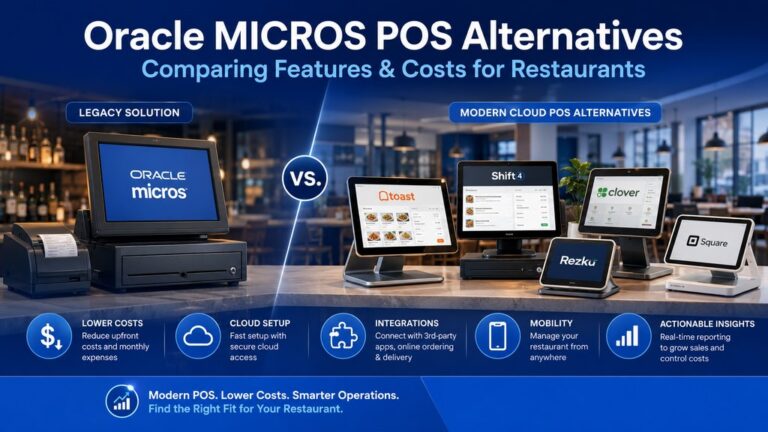
If neither Toast nor MICROS fits, the next step is to shortlist alternatives based on operational model, not brand popularity. The right Toast POS alternatives depend on whether the business needs restaurant simplicity, enterprise hospitality depth, or a middle ground.
This is also where Shift4 vs Toast vs MICROS becomes a valid comparison.
For restaurant operators who want a more practical restaurant-first system than legacy-heavy stacks, but do not want to ignore payments and operational realities, Shift4 Dine (formerly SkyTab POS) can be part of the conversation. Because of the rebrand, older materials may still refer to SkyTab POS. In current positioning, the correct framing is Shift4 Dine, formerly SkyTab POS.
From implementation experience, Shift4 Dine is usually strongest when the buyer wants:
- practical restaurant workflows;
- simpler front-of-house adoption;
- cleaner menu and check logic;
- close alignment between POS and payment operations;
- a less enterprise-heavy environment than Simphony.
"SkyTab POS has been a heaven-sent system for us. The system itself is so user-friendly and the staff — Max and Julian — made the conversion so seamless. They have 24-hour customer service so you have access to getting any issues resolved at any time of the day, 7 days a week." — Client review (Case #5)
That does not make Shift4 Dine a universal replacement for MICROS in hotels, OPERA-linked properties, or venue-grade enterprise stacks. It belongs on the shortlist when the operation is restaurant-led rather than hospitality-infrastructure-led.
When evaluating any alternative, use the same filter:
- processor flexibility;
- deployment model;
- integration depth;
- offline mode;
- multi-location management;
- contract terms;
- hardware durability;
- migration risk.
The short version:
- Choose Toast if simplicity, restaurant-first workflows, and faster rollout are the main priorities.
- Choose Oracle MICROS Simphony if enterprise hospitality, hotel PMS integration, OPERA context, stadiums and venues, or long-horizon system governance drive the decision.
- Review Shift4 Dine (formerly SkyTab POS) when the operation wants practical restaurant execution without enterprise hospitality overhead.
If you are already on MICROS and Toast is pitching hard, do not compare only demos. Compare the operating model, payment model, and migration risk. That is where the real answer shows up.
For a broader look at what else is on the market beyond these three, the Oracle MICROS POS alternatives overview covers additional options by segment and use case.
Last reviewed: Q2 2026. Pricing ranges reflect publicly available information and partner market references. Confirm all figures directly with Oracle, Toast, or your payment integrator before committing to a contract.
FAQ
FAQ
Can I use my own payment processor with Toast?
Toast requires use of Toast Payments for most configurations, especially on the Starter Kit. Using a third-party processor is possible in some cases but typically requires a higher software subscription fee. Always confirm processor flexibility and the impact on your blended rate before signing.
Does Toast integrate with OPERA or hotel PMS systems?
Toast does not have the same native depth of hotel PMS and OPERA integration that MICROS Simphony does. If room-charge capability, PMS linkage, or hotel billing workflows are requirements, MICROS is the more natural starting point.
What happened to the original MICROS brand?
Oracle acquired MICROS Systems in 2014 for approximately $5.3 billion and folded it into its Oracle Hospitality and Food & Beverage business unit. The RES 3700 (the most common legacy terminal) is no longer sold by Oracle. All current Oracle restaurant development focuses on Simphony.
What is the difference between Simphony Essentials and Simphony Plus?
Simphony Essentials targets small- and medium-sized restaurants with a pay-as-you-go metered model, starting at approximately $55/month per terminal. Simphony Plus is positioned for multi-location and enterprise operators with broader modules including reporting analytics and labor management, starting at approximately $75/month. Enterprise single-tenant pricing is custom-quoted.
How long does a MICROS to Toast migration typically take?
Single-location migrations with straightforward setups can take a few days to one week. Multi-location migrations with complex integrations, reporting dependencies, and staff retraining typically take several weeks. Plan for a parallel running period and build retraining time into labor planning.
Is old MICROS hardware compatible with Toast?
No. Toast uses its own proprietary hardware ecosystem. Switching from MICROS to Toast requires a full device fleet replacement. Toast and Oracle both run promotions periodically — verify current offers before budgeting.
What is Windows 10 EOL and why does it matter for MICROS?
Microsoft ended support for Windows 10 on October 14, 2025. Many legacy MICROS RES 3700 terminals run on Windows 10. Without active OS support, these systems face increasing security compliance risk, growing PCI audit complexity, and a shrinking pool of available spare parts.
How should I calculate 3-year TCO for MICROS vs Toast?
Key variables to model: number of terminals, monthly transaction volume and average ticket, card mix, selected software modules, implementation cost, integration fees, hardware replacement assumptions, and blended processing rate over the full contract period. The system that looks cheaper at the starting line often changes when processing economics are fully modeled.
What is the difference between Simphony Cloud and the legacy RES 3700?
RES 3700 is Oracle’s legacy on-premise terminal, no longer sold or actively developed. Simphony Cloud is Oracle’s current cloud-based platform — actively maintained, with regular updates, cloud integrations, and a modern API layer. If you are on RES 3700 and evaluating options, Simphony Cloud is the Oracle-native upgrade path. Whether it is the right path depends on your scale and integration requirements.